Physics for Electronics Engineering: Unit III: Semiconductors and Transport Physics
Hall Devices
Types
The device which uses the hall effect for its application is known as Hall device.
HALL DEVICES
The
device which uses the hall effect for its application is known as Hall device.
There
are three types of Hall devices.
They
are
(a)
Gauss Meter
(b)
Electronic Multiplier
(c)
Electronic Wattmeter
(a)
Gauss Meter
The
Hall voltage 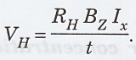 In this, VH ∞ BZ for given hall
element; RH and t are constant. The current I through Hall element
is also kept constant.
In this, VH ∞ BZ for given hall
element; RH and t are constant. The current I through Hall element
is also kept constant.
This principle is used in Gauss meter. It is used for measuring magnetic field. (Fig. 3.19)
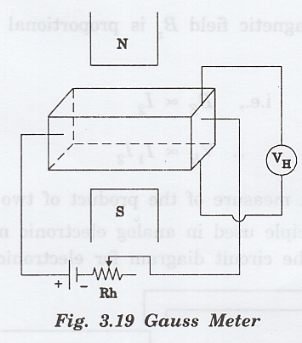
The
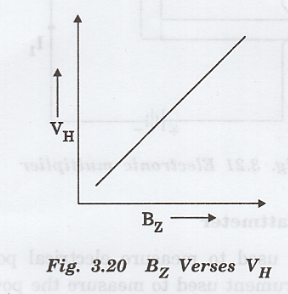
variation of Hall voltage with magnetic field is shown in fig. 3.20. The
voltmeter which is used to measure VH can be directly calibrated in
terms of Gauss. The graph can be also used to measure any unknown magnetic
fields.
(b)
Electronic Multipliers
From
Hall effect, we have 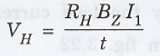
Since RH and t are constant for an
element
VH ∞ BZ I1
But,
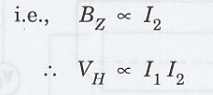
the magnetic field BZ is proportional to current (I2)
through the coil.
i.e.,
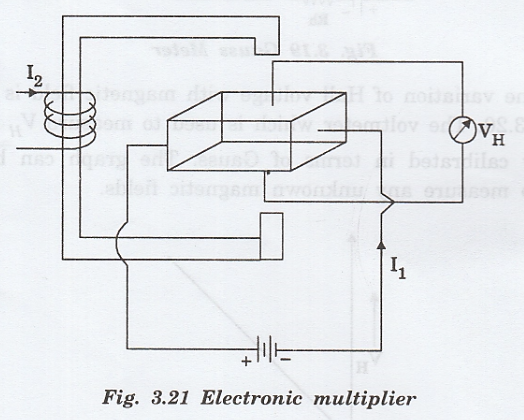
VH is a measure of the product of two currents. This is the basic
principle used in analog electronic multipliers. The fig. 3.21 shows the
circuit diagram for electronic multiplier.
(c)
Electronic Wattmeter
Hall
effect is used to measure electrical power dissipated in a load. The instrument
used to measure the power in a circuit using Hall effect principle is known as
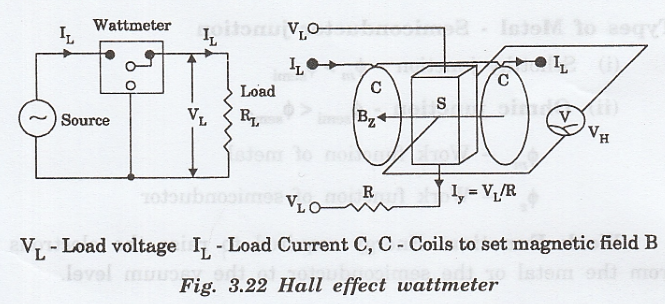
Hall effect - Watt meter.
S
is Hall effect sample. It is placed in a magnetic field BZ produced
by the load current IL passing through the coils CC as shown in fig.
3.22.
The
voltage across the load VL drives the current  through
the sample. R is a series resistance which is
through
the sample. R is a series resistance which is
>>
than the resistance of the sample and that of the load. Also IL <<
IL
If
't' thickness of the sample, then the measured Hall voltage
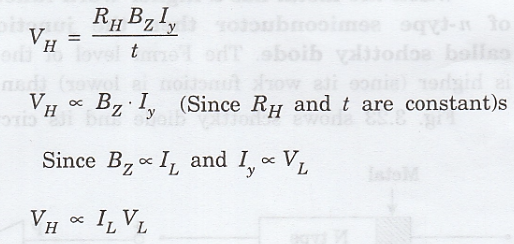
This
is the electric power dissipated by the load. The voltmeter that measures VH
can be calibrated to read power directly.
Metal
Semiconductor (MS) Contact
Metal-Semiconductor
(MS) contact plays a very important role in the present day electronic devices
and Integrated Circuit (IC) technology..
When a metal and a semiconductor are brought into contact, there are two types of junctions formed depending on the work functions of the metal and semiconductor.
Types of Metal-Semiconductor
junction
(i)
Schottky junction – Φm > Φsemi
(ii)
Ohmic junction – Φsemi < Φsemi
Φm
– Work function of metal
Φz
– Work function of semiconductor
Work
Function: Energy required to raise the electrons from the metal or the
semiconductor to the vacuum level.
Physics for Electronics Engineering: Unit III: Semiconductors and Transport Physics : Tag: : Types - Hall Devices
Physics for Electronics Engineering: Unit III: Semiconductors and Transport Physics
Under Subject
Physics for Electronics Engineering
PH3254 - Physics II - 2nd Semester - ECE Department - 2021 Regulation | 2nd Semester ECE Dept 2021 Regulation
Related Subjects
Professional English II
HS3251 2nd Semester 2021 Regulation | 2nd Semester Common to all Dept 2021 Regulation
Statistics and Numerical Methods
MA3251 2nd Semester 2021 Regulation M2 Engineering Mathematics 2 | 2nd Semester Common to all Dept 2021 Regulation
Engineering Graphics
GE3251 eg 2nd semester | 2021 Regulation | 2nd Semester Common to all Dept 2021 Regulation
Physics for Electrical Engineering
PH3202 2nd Semester 2021 Regulation | 2nd Semester EEE Dept 2021 Regulation
Basic Civil and Mechanical Engineering
BE3255 2nd Semester 2021 Regulation | 2nd Semester EEE Dept 2021 Regulation
Electric Circuit Analysis
EE3251 2nd Semester 2021 Regulation | 2nd Semester EEE Dept 2021 Regulation
Physics for Electronics Engineering
PH3254 - Physics II - 2nd Semester - ECE Department - 2021 Regulation | 2nd Semester ECE Dept 2021 Regulation
Electrical and Instrumentation Engineering
BE3254 - 2nd Semester - ECE Dept - 2021 Regulation | 2nd Semester ECE Dept 2021 Regulation
Circuit Analysis
EC3251 - 2nd Semester - ECE Dept - 2021 Regulation | 2nd Semester ECE Dept 2021 Regulation
Materials Science
PH3251 2nd semester Mechanical Dept | 2021 Regulation | 2nd Semester Mechanical Dept 2021 Regulation
Basic Electrical and Electronics Engineering
BE3251 2nd semester Mechanical Dept | 2021 Regulation | 2nd Semester Mechanical Dept 2021 Regulation
Physics for Civil Engineering
PH3201 2021 Regulation | 2nd Semester Civil Dept 2021 Regulation
Basic Electrical, Electronics and Instrumentation Engineering
BE3252 2021 Regulation | 2nd Semester Civil Dept 2021 Regulation
Physics for Information Science
PH3256 2nd Semester CSE Dept | 2021 Regulation | 2nd Semester CSE Dept 2021 Regulation
Basic Electrical and Electronics Engineering
BE3251 2nd Semester CSE Dept 2021 | Regulation | 2nd Semester CSE Dept 2021 Regulation
Programming in C
CS3251 2nd Semester CSE Dept 2021 | Regulation | 2nd Semester CSE Dept 2021 Regulation