Physics for Electronics Engineering: Unit III: Semiconductors and Transport Physics
Variation of Carrier Concentration with Temperature and Impurity
In extrinsic semiconductor, the resistivity decreases linearly with increase in temperature. This variation is considered under three different regions.
VARIATION OF CARRIER CONCENTRATION WITH TEMPERATURE AND IMPURITY
In
extrinsic semiconductor, the resistivity decreases linearly with increase in
temperature. This variation is considered under three different regions.
i)
Extrinsic or impurity range
ii)
Exhaustion range
iii)
Intrinsic range
For
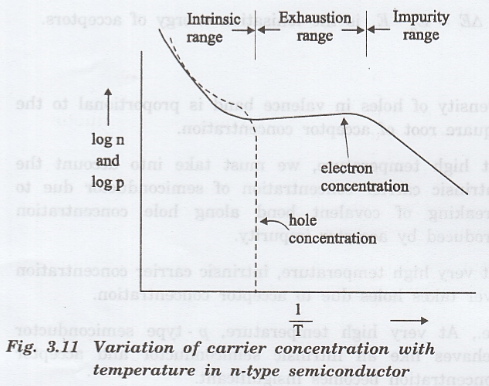
a n-type semiconductor, the variation of carrier concentration n and p with
temperature is shown in fig. 3.11.
At
OK, both conduction and valence bands are free from any charge carriers and
hence, the electrical conductivity is zero.
With
increase in temperature, the donor atoms get ionised and hence electron
concentration in conduction band increases with temperature until all the donor
atoms are ionised. This range is known as impurity or extrinsic range.
When
the temperature is further increased to room temperature, there are no more
donor atoms to be ionised and hence the concentration of electrons in
conduction band remains constant over a certain temperature range. This region
is known as exhaustion range.
As
the temperature is increased further, the electrons in valence band are lifted
across the forbidden gap to conduction band. Thus, electron concentration
increases in conduction band considerably.
With
further increase in temperature, more and more electrons from valence band
reach conduction band and completely out-number the donor electrons.
The
material practically becomes intrinsic and so this range is called intrinsic
range. All these ranges are shown in fig. 3.11.
The dotted curve indicates hole concentration in an intrinsic range.
Table 3.4
Differences between intrinsic and
extrinsic semiconductors
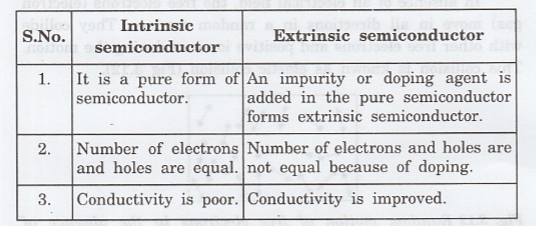
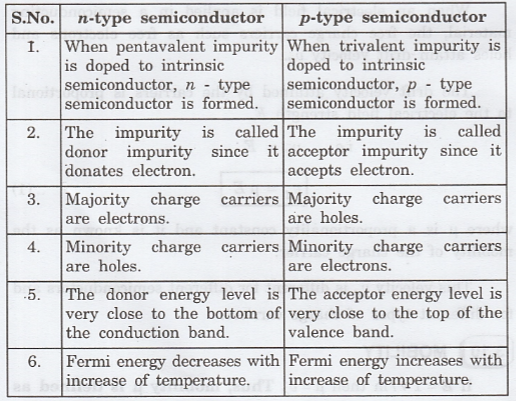
Table 3.5
Differences between n type and
p-type semiconductors
Physics for Electronics Engineering: Unit III: Semiconductors and Transport Physics : Tag: : - Variation of Carrier Concentration with Temperature and Impurity
Physics for Electronics Engineering: Unit III: Semiconductors and Transport Physics
Under Subject
Physics for Electronics Engineering
PH3254 - Physics II - 2nd Semester - ECE Department - 2021 Regulation | 2nd Semester ECE Dept 2021 Regulation
Related Subjects
Professional English II
HS3251 2nd Semester 2021 Regulation | 2nd Semester Common to all Dept 2021 Regulation
Statistics and Numerical Methods
MA3251 2nd Semester 2021 Regulation M2 Engineering Mathematics 2 | 2nd Semester Common to all Dept 2021 Regulation
Engineering Graphics
GE3251 eg 2nd semester | 2021 Regulation | 2nd Semester Common to all Dept 2021 Regulation
Physics for Electrical Engineering
PH3202 2nd Semester 2021 Regulation | 2nd Semester EEE Dept 2021 Regulation
Basic Civil and Mechanical Engineering
BE3255 2nd Semester 2021 Regulation | 2nd Semester EEE Dept 2021 Regulation
Electric Circuit Analysis
EE3251 2nd Semester 2021 Regulation | 2nd Semester EEE Dept 2021 Regulation
Physics for Electronics Engineering
PH3254 - Physics II - 2nd Semester - ECE Department - 2021 Regulation | 2nd Semester ECE Dept 2021 Regulation
Electrical and Instrumentation Engineering
BE3254 - 2nd Semester - ECE Dept - 2021 Regulation | 2nd Semester ECE Dept 2021 Regulation
Circuit Analysis
EC3251 - 2nd Semester - ECE Dept - 2021 Regulation | 2nd Semester ECE Dept 2021 Regulation
Materials Science
PH3251 2nd semester Mechanical Dept | 2021 Regulation | 2nd Semester Mechanical Dept 2021 Regulation
Basic Electrical and Electronics Engineering
BE3251 2nd semester Mechanical Dept | 2021 Regulation | 2nd Semester Mechanical Dept 2021 Regulation
Physics for Civil Engineering
PH3201 2021 Regulation | 2nd Semester Civil Dept 2021 Regulation
Basic Electrical, Electronics and Instrumentation Engineering
BE3252 2021 Regulation | 2nd Semester Civil Dept 2021 Regulation
Physics for Information Science
PH3256 2nd Semester CSE Dept | 2021 Regulation | 2nd Semester CSE Dept 2021 Regulation
Basic Electrical and Electronics Engineering
BE3251 2nd Semester CSE Dept 2021 | Regulation | 2nd Semester CSE Dept 2021 Regulation
Programming in C
CS3251 2nd Semester CSE Dept 2021 | Regulation | 2nd Semester CSE Dept 2021 Regulation