Physics for Electronics Engineering: Unit III: Semiconductors and Transport Physics
Extrinsic or Impure Semiconductors
Doping, Advantages, Types
In a semiconducting material, if the charge carriers originate from impurity atoms which are doped to the original material, then this type of semiconductor is known as extrinsic or impure semiconductor.
EXTRINSIC OR IMPURE SEMICONDUCTORS
In
a semiconducting material, if the charge carriers originate from impurity atoms
which are doped to the original material, then this type of semiconductor is
known as extrinsic or impure semiconductor.
It
is also known as doped semiconductor.
Extrinsic
semiconductor is obtained by adding trivalent or pentavalent impurity atoms to
a tetravalent semiconductor. The electrical properties of pure semiconductors
can be easily changed even with the addition of very little amount of
impurities.
Doping
The
addition of impurities to a pure semiconductor is known as doping and added
impurity is called as doping agent or dopant.
The addition of impurities increases the number of free electrons and holes in semiconductor and hence increases its electrical conductivity.
Some
of the common doping agents are arsenic, antimony, phosphorus, gallium,
aluminum and boron. These elements have either five or three valence electrons
in the outermost orbit.
Advantages of Extrinsic
semiconductors
i.
Electrical conductivity is high.
ii.
Electrical conductivity can be altered to any desired ΠΟΙ value by controlling
of doping concentration.
iii.
Electrical conductivity is not a function of temperature.
Types of Extrinsic semiconductors
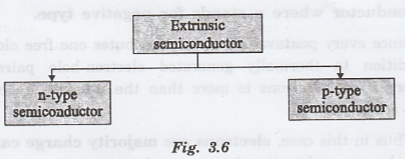
The extrinsic semiconductors are classified into two types based on the type of impurity added. (Fig 3.6)
(i)
n-type semiconductor
(ii)
p-type semiconductor
Physics for Electronics Engineering: Unit III: Semiconductors and Transport Physics : Tag: : Doping, Advantages, Types - Extrinsic or Impure Semiconductors
Physics for Electronics Engineering: Unit III: Semiconductors and Transport Physics
Under Subject
Physics for Electronics Engineering
PH3254 - Physics II - 2nd Semester - ECE Department - 2021 Regulation | 2nd Semester ECE Dept 2021 Regulation
Related Subjects
Professional English II
HS3251 2nd Semester 2021 Regulation | 2nd Semester Common to all Dept 2021 Regulation
Statistics and Numerical Methods
MA3251 2nd Semester 2021 Regulation M2 Engineering Mathematics 2 | 2nd Semester Common to all Dept 2021 Regulation
Engineering Graphics
GE3251 eg 2nd semester | 2021 Regulation | 2nd Semester Common to all Dept 2021 Regulation
Physics for Electrical Engineering
PH3202 2nd Semester 2021 Regulation | 2nd Semester EEE Dept 2021 Regulation
Basic Civil and Mechanical Engineering
BE3255 2nd Semester 2021 Regulation | 2nd Semester EEE Dept 2021 Regulation
Electric Circuit Analysis
EE3251 2nd Semester 2021 Regulation | 2nd Semester EEE Dept 2021 Regulation
Physics for Electronics Engineering
PH3254 - Physics II - 2nd Semester - ECE Department - 2021 Regulation | 2nd Semester ECE Dept 2021 Regulation
Electrical and Instrumentation Engineering
BE3254 - 2nd Semester - ECE Dept - 2021 Regulation | 2nd Semester ECE Dept 2021 Regulation
Circuit Analysis
EC3251 - 2nd Semester - ECE Dept - 2021 Regulation | 2nd Semester ECE Dept 2021 Regulation
Materials Science
PH3251 2nd semester Mechanical Dept | 2021 Regulation | 2nd Semester Mechanical Dept 2021 Regulation
Basic Electrical and Electronics Engineering
BE3251 2nd semester Mechanical Dept | 2021 Regulation | 2nd Semester Mechanical Dept 2021 Regulation
Physics for Civil Engineering
PH3201 2021 Regulation | 2nd Semester Civil Dept 2021 Regulation
Basic Electrical, Electronics and Instrumentation Engineering
BE3252 2021 Regulation | 2nd Semester Civil Dept 2021 Regulation
Physics for Information Science
PH3256 2nd Semester CSE Dept | 2021 Regulation | 2nd Semester CSE Dept 2021 Regulation
Basic Electrical and Electronics Engineering
BE3251 2nd Semester CSE Dept 2021 | Regulation | 2nd Semester CSE Dept 2021 Regulation
Programming in C
CS3251 2nd Semester CSE Dept 2021 | Regulation | 2nd Semester CSE Dept 2021 Regulation