Physics for Electronics Engineering: Unit III: Semiconductors and Transport Physics
n - type Semiconductor
Covalent bond, Energy band, Crystal Structure, Diagram
When a small amount of pentavalent impurity (group V element) is doped to a pure semiconductor, it becomes n-type semiconductor.
n-type semiconductor
When
a small amount of pentavalent impurity (group V element) is doped to a pure
semiconductor, it becomes n-type semiconductor.
Such
impurities are known as donor impurities because they donate free electrons to
semiconductor crystal.
Typical
examples of pentavalent impurities are phosphorus, (Atomic No. 15) and antimony
(Atomic No. 51).
Covalent bond in n-type
semiconductor
A
pentavalent impurity (phosphorus) having five valence electrons is added to a
pure semiconductor having four valence electrons (silicon or germanium).
Now,
four electrons of germanium form a covalent bond with four valence electrons of
phosphorus (impurity atom).
The
fifth electron which is now free finds no place in covalent bond structure as
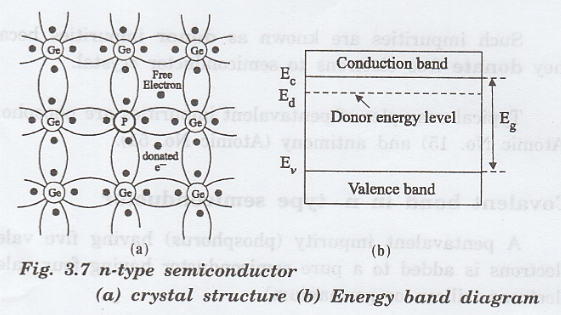
shown in fig. 3.7 (a).
We have one electron left free. This acts as a conduction electron. A very small amount of energy (0.01 eV for germanium and 0.05 eV for silicon) is needed to detach this fifth electron.
The
addition of pentavalent impurity gives a large number of free electrons
(negative charges) in semiconductor. Therefore, it is called n-type
semiconductor where n stands for negative type.
Since
every pentavalent atom contributes one free electron, in addition to thermally
generated electron-hole pairs, the number of free electrons is more than the
number of holes in n-type semiconductor.
Thus
in this case, electrons are majority charge carriers and holes are minority
charge carriers.
Energy band of n-type semiconductor
The
energy band diagram of n-type semiconductor is shown in fig.3.7 (b). When the
donor impurities are added, the allowable energy levels (donor energy levels)
are introduced.
These
donor energy levels are slightly below the conduction band. They are discrete
and do not form a band because the impurity atoms are far away in the crystal
and hence their interaction is small.
The
donor energy level for germanium is 0.01 eV and for silicon it is 0.05 eV below
the conduction band. Therefore, even at room temperature, almost all the fifth
electrons enter into the conduction band.
Physics for Electronics Engineering: Unit III: Semiconductors and Transport Physics : Tag: : Covalent bond, Energy band, Crystal Structure, Diagram - n - type Semiconductor
Physics for Electronics Engineering: Unit III: Semiconductors and Transport Physics
Under Subject
Physics for Electronics Engineering
PH3254 - Physics II - 2nd Semester - ECE Department - 2021 Regulation | 2nd Semester ECE Dept 2021 Regulation
Related Subjects
Professional English II
HS3251 2nd Semester 2021 Regulation | 2nd Semester Common to all Dept 2021 Regulation
Statistics and Numerical Methods
MA3251 2nd Semester 2021 Regulation M2 Engineering Mathematics 2 | 2nd Semester Common to all Dept 2021 Regulation
Engineering Graphics
GE3251 eg 2nd semester | 2021 Regulation | 2nd Semester Common to all Dept 2021 Regulation
Physics for Electrical Engineering
PH3202 2nd Semester 2021 Regulation | 2nd Semester EEE Dept 2021 Regulation
Basic Civil and Mechanical Engineering
BE3255 2nd Semester 2021 Regulation | 2nd Semester EEE Dept 2021 Regulation
Electric Circuit Analysis
EE3251 2nd Semester 2021 Regulation | 2nd Semester EEE Dept 2021 Regulation
Physics for Electronics Engineering
PH3254 - Physics II - 2nd Semester - ECE Department - 2021 Regulation | 2nd Semester ECE Dept 2021 Regulation
Electrical and Instrumentation Engineering
BE3254 - 2nd Semester - ECE Dept - 2021 Regulation | 2nd Semester ECE Dept 2021 Regulation
Circuit Analysis
EC3251 - 2nd Semester - ECE Dept - 2021 Regulation | 2nd Semester ECE Dept 2021 Regulation
Materials Science
PH3251 2nd semester Mechanical Dept | 2021 Regulation | 2nd Semester Mechanical Dept 2021 Regulation
Basic Electrical and Electronics Engineering
BE3251 2nd semester Mechanical Dept | 2021 Regulation | 2nd Semester Mechanical Dept 2021 Regulation
Physics for Civil Engineering
PH3201 2021 Regulation | 2nd Semester Civil Dept 2021 Regulation
Basic Electrical, Electronics and Instrumentation Engineering
BE3252 2021 Regulation | 2nd Semester Civil Dept 2021 Regulation
Physics for Information Science
PH3256 2nd Semester CSE Dept | 2021 Regulation | 2nd Semester CSE Dept 2021 Regulation
Basic Electrical and Electronics Engineering
BE3251 2nd Semester CSE Dept 2021 | Regulation | 2nd Semester CSE Dept 2021 Regulation
Programming in C
CS3251 2nd Semester CSE Dept 2021 | Regulation | 2nd Semester CSE Dept 2021 Regulation