Physics for Electronics Engineering: Unit III: Semiconductors and Transport Physics
Concentration of Holes in Valence Band of p-type Semiconductors
Derivation
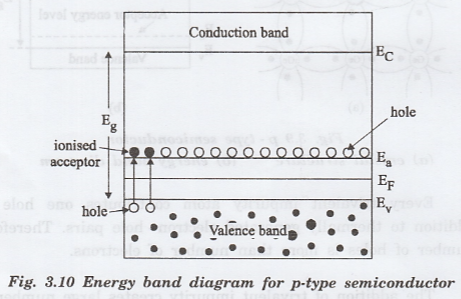
In p-type semiconductor, acceptor energy level is just above valence band
CONCENTRATION OF HOLES IN VALENCE BAND OF P-TYPE SEMICONDUCTORS
[Derivation]
In
p-type semiconductor, acceptor energy level is just above valence band (fig.
3.10).
Density
of holes per unit volume in valence band is given by

Ev → Energy corresponding to
top most level of valence band.
Density
of ionised acceptors = Na F(Ea)
N-the
number of acceptor atoms per unit volume.
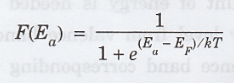
Ea-
acceptor energy level
Here, F(Ea) is probability for finding electron in acceptor energy level ie., ionised acceptor.
The
eqn (1) becomes, density of ionised acceptors

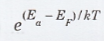 is a large quantity and thus '1' from the (a) e denominator of R.H.S. of eqn
(2) is neglected.
is a large quantity and thus '1' from the (a) e denominator of R.H.S. of eqn
(2) is neglected.
Now,
the eqn (2) is modified as,
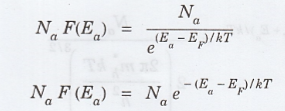
Density
of ionised acceptors 
At
equilibrium,
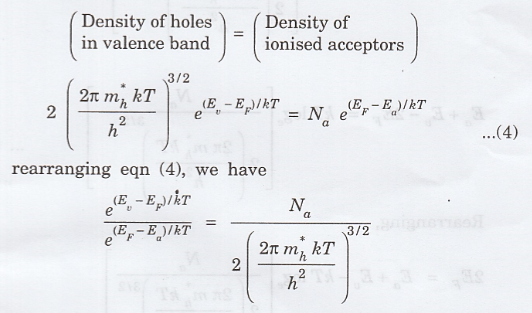
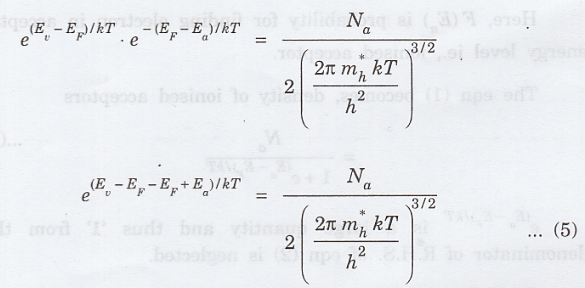
Taking
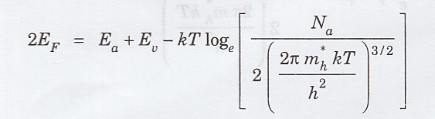
log on both sides in eqn (5), we have

Rearranging,
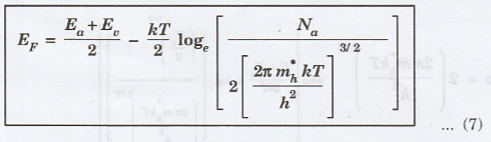
Substituting
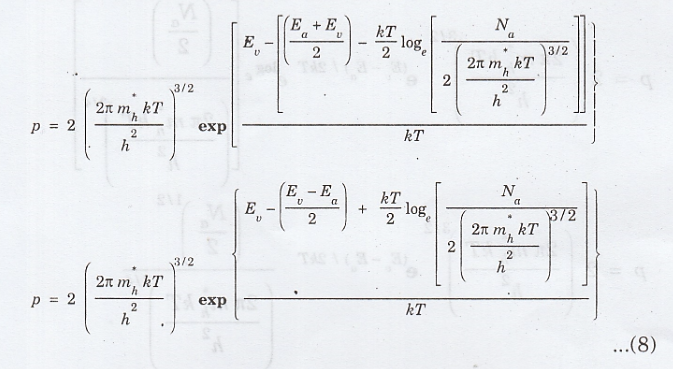
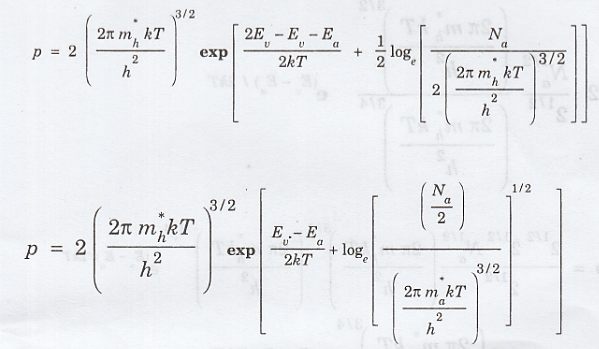
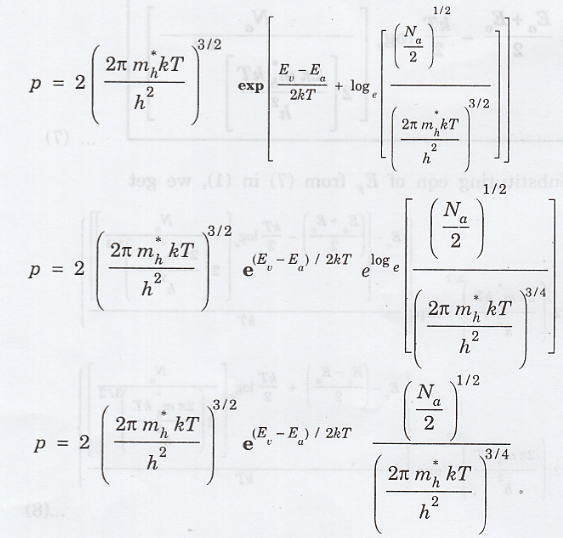
eqn of EF from (7) in (1), we get

where
∆E = Ea – Ev is the ionisation energy of acceptors.
Results
i.
Density of holes in valence band is proportional to the square root of acceptor
concentration.
ii.
At high temperature, we must take into account the intrinsic carrier concentration
of semiconductor due to breaking of covalent bond along hole concentration
produced by acceptor impurity.
iii.
At very high temperature, intrinsic carrier concentration over takes holes due
to acceptor concentration.
iv.
i.e., At very high temperature, p-type semiconductor behaves like an intrinsic
semiconductor and acceptor concentration becomes insignificant.
Physics for Electronics Engineering: Unit III: Semiconductors and Transport Physics : Tag: : Derivation - Concentration of Holes in Valence Band of p-type Semiconductors
Physics for Electronics Engineering: Unit III: Semiconductors and Transport Physics
Under Subject
Physics for Electronics Engineering
PH3254 - Physics II - 2nd Semester - ECE Department - 2021 Regulation | 2nd Semester ECE Dept 2021 Regulation
Related Subjects

Professional English II
HS3251 2nd Semester 2021 Regulation | 2nd Semester Common to all Dept 2021 Regulation
Statistics and Numerical Methods
MA3251 2nd Semester 2021 Regulation M2 Engineering Mathematics 2 | 2nd Semester Common to all Dept 2021 Regulation
Engineering Graphics
GE3251 eg 2nd semester | 2021 Regulation | 2nd Semester Common to all Dept 2021 Regulation

Physics for Electrical Engineering
PH3202 2nd Semester 2021 Regulation | 2nd Semester EEE Dept 2021 Regulation
Basic Civil and Mechanical Engineering
BE3255 2nd Semester 2021 Regulation | 2nd Semester EEE Dept 2021 Regulation
Electric Circuit Analysis
EE3251 2nd Semester 2021 Regulation | 2nd Semester EEE Dept 2021 Regulation
Physics for Electronics Engineering
PH3254 - Physics II - 2nd Semester - ECE Department - 2021 Regulation | 2nd Semester ECE Dept 2021 Regulation

Electrical and Instrumentation Engineering
BE3254 - 2nd Semester - ECE Dept - 2021 Regulation | 2nd Semester ECE Dept 2021 Regulation
Circuit Analysis
EC3251 - 2nd Semester - ECE Dept - 2021 Regulation | 2nd Semester ECE Dept 2021 Regulation
Materials Science
PH3251 2nd semester Mechanical Dept | 2021 Regulation | 2nd Semester Mechanical Dept 2021 Regulation

Basic Electrical and Electronics Engineering
BE3251 2nd semester Mechanical Dept | 2021 Regulation | 2nd Semester Mechanical Dept 2021 Regulation
Physics for Civil Engineering
PH3201 2021 Regulation | 2nd Semester Civil Dept 2021 Regulation

Basic Electrical, Electronics and Instrumentation Engineering
BE3252 2021 Regulation | 2nd Semester Civil Dept 2021 Regulation
Physics for Information Science
PH3256 2nd Semester CSE Dept | 2021 Regulation | 2nd Semester CSE Dept 2021 Regulation

Basic Electrical and Electronics Engineering
BE3251 2nd Semester CSE Dept 2021 | Regulation | 2nd Semester CSE Dept 2021 Regulation
Programming in C
CS3251 2nd Semester CSE Dept 2021 | Regulation | 2nd Semester CSE Dept 2021 Regulation