Physics for Electronics Engineering: Unit II: Electrical and Magnetic Properties of Materials
Fermi-Dirac Statistics
Definition, Formula, Example Problems, Derivation, Energy Levels, Uses | Electrical Properties of Materials
Fermi - Dirac statistics deals with the particles having half integral spin like electrons. They are known as Fermi particles or Fermions. Fermi distribution function gives the distribution of electrons among the various energy levels as a function of temperature.
FERMI-DIRAC STATISTICS
Fermi
- Dirac statistics deals with the particles having half integral spin like
electrons. They are known as Fermi particles or Fermions.
Definition
Fermi
distribution function gives the distribution of electrons among the various
energy levels as a function of temperature.
It
is a probability function F(E) of an electron occupancy for a given energy
level at absolute temperature.
It
is given by
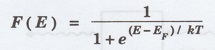
where
E
- Energy of the level whose occupancy is being considered
EF
- Fermi energy level
k - Boltzmann's
constant
T
- Absolute temperature
The
probability value F(E) lies between 0 and 1.
i.
If F (E) = 1, the energy level is occupied by an electron.
ii.
If F (E) = 0, the energy level is vacant ie., it is not occupied by the
electron.
iii. If F (E) = 0.5 or 1/2 then there is a 50% chance for the electron occupying in that energy level.
ANNA UNIVERSITY SOLVED PROBLEM
Problem 2.3
Use
Fermi distribution function to obtain the value of F(E) for E - EF =
0.01 eV at 200 K. (A.U. May 2015)
Given data
E
– EF = 0.01 eV = 0.01 × 1.6 × 10-19 J = 1.6 × 10⁻²¹
J
Temperature
T = 200 K
Boltzmann's
constant k = 1.38 × 10⁻²³
JK-1
Solution
We
know that 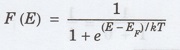
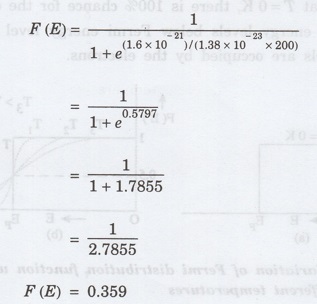
Substituting
the given values, we have
Effect of Temperature on Fermi
Function
The
dependence of Fermi distribution function on temperature and its effect on the
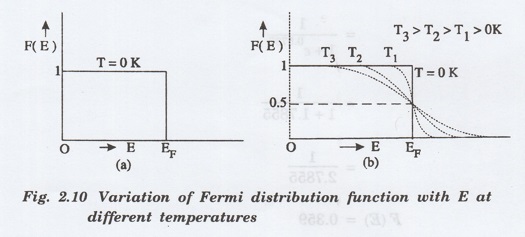
occupancy of energy level is shown in fig. 2.10 (a) and (b).
Case (i) Probability of occupation
for E < EF at T = 0 K
When
T = 0 K and E < EF then applying the values in the expression, we
have
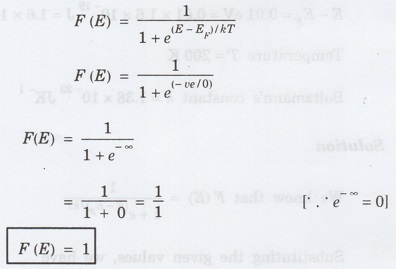
Thus
at T = 0 K, there is 100% chance for the electrons to occupy the energy levels
below Fermi energy level ie., all the energy levels are occupied by the
electrons.
Case (ii) Probability of occupation
for E > EF at T = 0 K
When
T = 0 K and E > EF, then applying the values in the expression 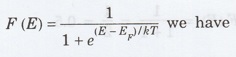
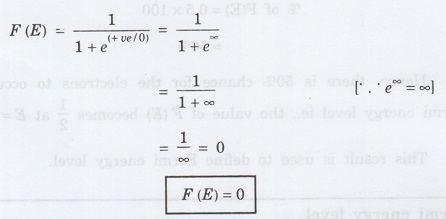
Thus,
there is 0% chance for the electrons to occupy the energy level above Fermi
energy level ie., all the energy levels above Fermi energy level are not
occupied by the electrons (empty).
From
the above two cases, at T = 0 K the variation of F (E) for different energy
values become a step function as shown in fig 2.10(a).
Case (iii) Probability of
occupation at ordinary temperature
At
ordinary temperature, the value of the probability function starts reducing
from 1 for energy values E slightly less than EF
With
the increase of temperature, i.e., T > 0 K, Fermi function F (E) varies with
E as shown in fig. 2.10(b).
At any temperature other than 0 K and E = EF
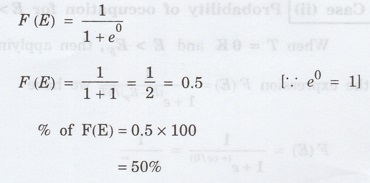
Hence,
there is 50% chance for the electrons to occupy Fermi energy level ie., the
value of F (E) becomes 1/2 at E = EF
This
result is used to define Fermi energy level.
Fermi
energy level
i. It is the energy level at any
finite temperature above 0 K at which the probability of electron occupation is
1/2 or 50%.
ii. It is also the energy level of
maximum energy of wore the filled states at 0 K.
Further
for E > EF, the probability value falls off rapidly to zero (Fig
2.10(b)).
Case (iv) At high temperature
When
kT >> EF or T → ∞,
the electrons lose their quantum mechanical character. Now, Fermi distribution
function reduces to classical Boltzmann distribution.
Uses of Fermi distribution function
i.
It gives the probability of an electron occupancy for a given energy level at a
given temperature.
ii. It is very useful to find the number of free electrons per unit volume at a given temperature.
iii. It is used to find Fermi energy of the metal.Physics for Electronics Engineering: Unit II: Electrical and Magnetic Properties of Materials : Tag: : Definition, Formula, Example Problems, Derivation, Energy Levels, Uses | Electrical Properties of Materials - Fermi-Dirac Statistics
Physics for Electronics Engineering: Unit II: Electrical and Magnetic Properties of Materials
Under Subject
Physics for Electronics Engineering
PH3254 - Physics II - 2nd Semester - ECE Department - 2021 Regulation | 2nd Semester ECE Dept 2021 Regulation
Related Subjects

Professional English II
HS3251 2nd Semester 2021 Regulation | 2nd Semester Common to all Dept 2021 Regulation
Statistics and Numerical Methods
MA3251 2nd Semester 2021 Regulation M2 Engineering Mathematics 2 | 2nd Semester Common to all Dept 2021 Regulation

Engineering Graphics
GE3251 eg 2nd semester | 2021 Regulation | 2nd Semester Common to all Dept 2021 Regulation

Physics for Electrical Engineering
PH3202 2nd Semester 2021 Regulation | 2nd Semester EEE Dept 2021 Regulation

Basic Civil and Mechanical Engineering
BE3255 2nd Semester 2021 Regulation | 2nd Semester EEE Dept 2021 Regulation
Electric Circuit Analysis
EE3251 2nd Semester 2021 Regulation | 2nd Semester EEE Dept 2021 Regulation
Physics for Electronics Engineering
PH3254 - Physics II - 2nd Semester - ECE Department - 2021 Regulation | 2nd Semester ECE Dept 2021 Regulation

Electrical and Instrumentation Engineering
BE3254 - 2nd Semester - ECE Dept - 2021 Regulation | 2nd Semester ECE Dept 2021 Regulation
Circuit Analysis
EC3251 - 2nd Semester - ECE Dept - 2021 Regulation | 2nd Semester ECE Dept 2021 Regulation
Materials Science
PH3251 2nd semester Mechanical Dept | 2021 Regulation | 2nd Semester Mechanical Dept 2021 Regulation

Basic Electrical and Electronics Engineering
BE3251 2nd semester Mechanical Dept | 2021 Regulation | 2nd Semester Mechanical Dept 2021 Regulation

Physics for Civil Engineering
PH3201 2021 Regulation | 2nd Semester Civil Dept 2021 Regulation

Basic Electrical, Electronics and Instrumentation Engineering
BE3252 2021 Regulation | 2nd Semester Civil Dept 2021 Regulation
Physics for Information Science
PH3256 2nd Semester CSE Dept | 2021 Regulation | 2nd Semester CSE Dept 2021 Regulation

Basic Electrical and Electronics Engineering
BE3251 2nd Semester CSE Dept 2021 | Regulation | 2nd Semester CSE Dept 2021 Regulation
Programming in C
CS3251 2nd Semester CSE Dept 2021 | Regulation | 2nd Semester CSE Dept 2021 Regulation