Physics for Electronics Engineering: Unit II: Electrical and Magnetic Properties of Materials
Classical Free Electron (CFE) Theory of Metals
Electrical Properties of Materials
The classical free electron theory of metals was proposed by P. Drude in the year 1900 to explain the electrical conduction in metal. This theory was further extended by H. A. Lorentz in the year 1909.
CLASSICAL FREE ELECTRON (CFE) THEORY OF
METALS
The
classical free electron theory of metals was proposed by P. Drude in the year
1900 to explain the electrical conduction in metal. This theory was further extended
by H. A. Lorentz in the year 1909.
We
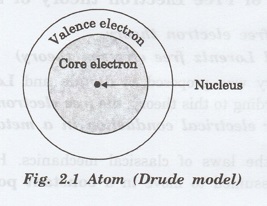
know that an atom consists of a central nucleus with positively charged protons
surrounded by the electrons of negative charge.
The
electrons in the inner shells are called core electrons and those in the
outermost shell are called valence electrons (Fig. 2.1).
In
a metal, when the valence electrons of each atom detach from the orbit, then
they move freely throughout the metal. These electrons are known as free or
conduction electrons.
Postulates of classical free electron theory
1.
According to this theory, a metal consists of very large number of free electrons.
These electrons move freely throughout the volume of the metal. The movement of
the free electrons is mainly responsible for the electrical conduction in the
metal.
2.
Drude assumed that the free electrons in the metal form an electron gas. They
move randomly in all possible directions just like the gas molecules move in a
container.
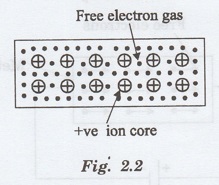
The
arrangement of atoms in a metal is viewed as an array of atoms (ions)
surrounded by a gas of free electrons. Here, the mutual repulsion between the
electrons is neglected. (Fig. 2.2)
3.
In absence of an electrical field, the free electrons (electron gas) move in
all directions in a random manner.
They collide with other free electrons and positive ion core during the motion. This collision is known as elastic collision (Fig 2.3).
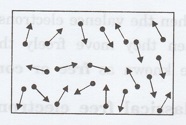
Fig. 2.3 Random motion of free
electrons in the absence of electric field (+ ve ion cores are not shown).
As
the motion is random, the resultant velocity in any particular direction is
zero.
4.
When the electrical field is applied the electrons get some amount of energy.
These electrons begin to move towards the positive potential (in opposite
direction to the applied electrical field).
They
continue to collide with positive ion cores fixed in the lattice. As a result,
the free electrons acquire a constant average velocity known as drift velocity
(Fig. 2.4).
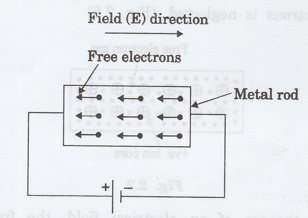
Fig. 2.4 Movement of free electrons
with applied electrical field
5.
The velocity and the energy distribution of free electrons are governed by
classical Maxwell distribution function.
6.
Since the electrons are assumed to be a perfect gas, they obey the laws of
kinetic theory of gases.
Therefore, the free electrons are assigned with mean free path, mean collision time and average velocity.
Drift velocity (vd)
It
is defined as the average velocity acquired by the free electrons of a metal in
a particular direction by the application of an electrical field.
It
is expressed as
vd
= λ / τc
where
λ - mean free path
τc
- collision time.
Mean free path (λ)
The
average distance travelled by a free electron between any two successive
collisions is known as mean free path. It is represented by λ.
It
is the product of drift velocity of free electrons (vd) and collision time (τc).
λ
= vd τc
Collision time (τc)
The
average time taken by a free electron between any two successive collisions is
known as collision time of the electron.
It
means that the electron on an average travels for a time τc before
its next collision.
It
is given by τc = λ / vd
where
λ - mean free path
vd - drift velocity
Relaxation time (τ)
The
average time taken by a free electron to reach its equilibrium state from its
disturbed state due to the application of an external electrical field is
called relaxation time.
In
other words, it is the measure of time that the electrons can relax when the
electrical field is removed. It is approximately equal to 10-14
second.
For
isotropic material such as metal collision time (τc) = relaxation
time (τ).
Physics for Electronics Engineering: Unit II: Electrical and Magnetic Properties of Materials : Tag: : Electrical Properties of Materials - Classical Free Electron (CFE) Theory of Metals
Physics for Electronics Engineering: Unit II: Electrical and Magnetic Properties of Materials
Under Subject
Physics for Electronics Engineering
PH3254 - Physics II - 2nd Semester - ECE Department - 2021 Regulation | 2nd Semester ECE Dept 2021 Regulation
Related Subjects

Professional English II
HS3251 2nd Semester 2021 Regulation | 2nd Semester Common to all Dept 2021 Regulation
Statistics and Numerical Methods
MA3251 2nd Semester 2021 Regulation M2 Engineering Mathematics 2 | 2nd Semester Common to all Dept 2021 Regulation
Engineering Graphics
GE3251 eg 2nd semester | 2021 Regulation | 2nd Semester Common to all Dept 2021 Regulation
Physics for Electrical Engineering
PH3202 2nd Semester 2021 Regulation | 2nd Semester EEE Dept 2021 Regulation
Basic Civil and Mechanical Engineering
BE3255 2nd Semester 2021 Regulation | 2nd Semester EEE Dept 2021 Regulation
Electric Circuit Analysis
EE3251 2nd Semester 2021 Regulation | 2nd Semester EEE Dept 2021 Regulation
Physics for Electronics Engineering
PH3254 - Physics II - 2nd Semester - ECE Department - 2021 Regulation | 2nd Semester ECE Dept 2021 Regulation
Electrical and Instrumentation Engineering
BE3254 - 2nd Semester - ECE Dept - 2021 Regulation | 2nd Semester ECE Dept 2021 Regulation
Circuit Analysis
EC3251 - 2nd Semester - ECE Dept - 2021 Regulation | 2nd Semester ECE Dept 2021 Regulation
Materials Science
PH3251 2nd semester Mechanical Dept | 2021 Regulation | 2nd Semester Mechanical Dept 2021 Regulation
Basic Electrical and Electronics Engineering
BE3251 2nd semester Mechanical Dept | 2021 Regulation | 2nd Semester Mechanical Dept 2021 Regulation
Physics for Civil Engineering
PH3201 2021 Regulation | 2nd Semester Civil Dept 2021 Regulation
Basic Electrical, Electronics and Instrumentation Engineering
BE3252 2021 Regulation | 2nd Semester Civil Dept 2021 Regulation
Physics for Information Science
PH3256 2nd Semester CSE Dept | 2021 Regulation | 2nd Semester CSE Dept 2021 Regulation
Basic Electrical and Electronics Engineering
BE3251 2nd Semester CSE Dept 2021 | Regulation | 2nd Semester CSE Dept 2021 Regulation
Programming in C
CS3251 2nd Semester CSE Dept 2021 | Regulation | 2nd Semester CSE Dept 2021 Regulation