Physics for Electronics Engineering: Unit II: Electrical and Magnetic Properties of Materials
Classification of Magnetic Materials
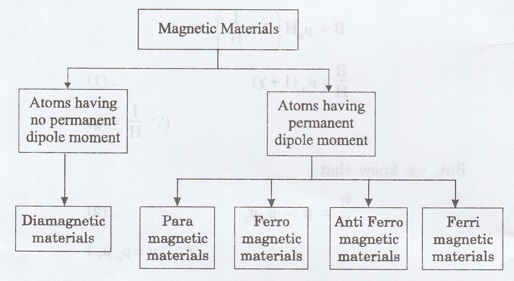
Magnetic materials are classified into two categories based on existence of dipole moment and the response of magnetic material to external magnetic fields
MAGNETIC MATERIALS - Classification
Magnetic
materials are classified into two categories based on existence of dipole
moment and the response of magnetic material to external magnetic fields
namely,
i.
Diamagnetic materials - no permanent magnetic moment.
ii. Paramagnetic, ferromagnetic, antiferromagnetic and ferrimagnetic materials - having permanent magnetic moment.
Generally,
diamagnetic and paramagnetic materials are known as non-magnetic materials, due
to poor response to an external magnetic field.
The
ferromagnetic, antiferromagnetic and ferrimagnetic materials are known as
magnetic materials. These materials strongly respond to an external magnetic
field.
DIAMAGNETIC EFFECT
Diamagnetism
is exhibited by all the materials.
The
atoms in diamagnetic materials do not possess permanent magnetic moments.
However,
when the diamagnetic material is placed in an external magnetic field, the
electrons in the atomic orbits tend to counteract the external magnetic field.
Hence, the atoms acquire an induced magnetic moment.
As
a result, the material becomes magnetised. The direction of the induced dipole
moment is opposite to that of externally applied magnetic field.
Due to this effect, the material is very weakly repelled in magnetic field. This phenomenon is known as diamagnetism.
We
can understand diamagnetism by the schematic illustration in fig 2.23 (a) and
(b).
When
the magnetic field H is zero, the atoms possess zero magnetic moment (fig 2.23
(a)).
When
a magnetic field H is applied in the direction shown (fig 2.23 (b)), the atoms
acquire an induced magnetic moment in the direction opposite to that of the
magnetic field.
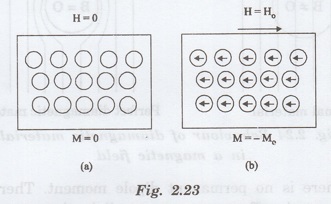
(a) Diamagnetic material. The atoms
do not possess possess magnetic moment.
(b) When a magnetic field H is
applied, the atoms acquire induced magnetic moment in the direction opposite to
the applied field resulting in negative susceptibility
The
strength of the induced magnetic moment is proportional to the applied field
and hence the magnetisation of the material varies directly with the strength
of the magnetic field.
The
induced dipoles and magnetization vanish as soon as the applied magnetic field
is removed.
The
susceptibility of the diamagnetic material is negative. Due to this, the
material is weakly repelled in the magnetic field.
Diamagnetic materials
The materials which exhibit diamagnetism are called diamagnetic materials.
Properties
i.
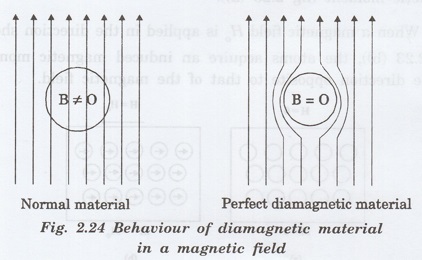
The diamagnetic materials repel the magnetic lines of force. The behaviour of a
perfect diamagnetic material in the presence of magnetic field is shown in fig.
2.24.
ii.
There is no permanent dipole moment. Therefore, the magnetic effects are very
small in these materials.
iii.
The magnetic susceptibility is negative and it does not depend on temperature
and applied magnetic field strength.
Example:
Gold, germanium and silicon.
PARAMAGNETIC EFFECT
In
certain materials, each atom or molecule possesses a net permanent magnetic
moment (due to orbital and spin magnetic moments) even in the absence of an
external magnetic field.
The
magnetic moments are randomly oriented in the absence of an external magnetic
field as shown in fig. 2.25(a). This makes the net magnetic moment zero and
hence the magnetisation of the material is zero.
But, when an external magnetic field is applied, the magnetic dipoles tend to align themselves in the direction of the magnetic field as shown in fig. 2.25(b) and the material becomes magnetized.
This
effect is known as paramagnetism.
With
an increase in temperature, increase in thermal agitation disturbs the
alignment of the magnetic moments.
It
tends to randomize the dipole direction thus leading to decrease in magnetization.
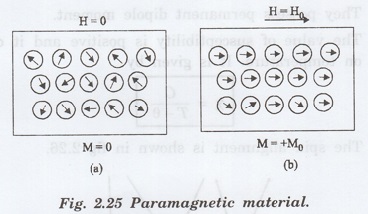
(a) Each atom possesses a permanent
magnetic moment. When H = 0, all the magnetic moments are randomly oriented so
M = 0.
(b) When a magnetic field H is
applied, the magnetic moments tend to orient themselves in the direction of the
field, resulting in positive susceptibility
This
indicates that the paramagnetic susceptibility decreases with increase in
temperature. It is noted that the paramagnetic susceptibility varies inversely
with temperature.
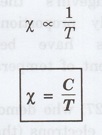
This is known as Curie's law of paramagnetism. C is a constant which is called as Curie's constant.
Paramagnetic
materials
The
magnetic materials which exhibit paramagnetism are called as paramagnetic
material.
Properties
i.
The paramagnetic materials attract the magnetic lines of force.
ii.
They possess permanent dipole moment.
iii.
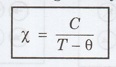
The value of susceptibility is positive and it depends on temperature. It is
given by
iv.
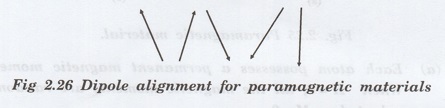
The spin alignment is shown in fig 2.26.
Example:
Manganous sulphate, ferric oxide, ferrous sulphate and nickel sulphate
FERROMAGNETIC EFFECT
Certain metals like iron (Fe), cobalt (Co), nickel (Ni) and certain alloys exhibit high degree of magnetisation.
These materials show the spontaneous magnetization i.e., they have magnetisation (atomic magnetic moments are aligned) even in the absence of an external magnetic field.
This indicates that there is a strong internal field within the material which makes the atomic magnetic moments align with each other.
This phenomenon is known as ferromagnetism
Physics for Electronics Engineering: Unit II: Electrical and Magnetic Properties of Materials : Tag: : - Classification of Magnetic Materials
Physics for Electronics Engineering: Unit II: Electrical and Magnetic Properties of Materials
Under Subject
Physics for Electronics Engineering
PH3254 - Physics II - 2nd Semester - ECE Department - 2021 Regulation | 2nd Semester ECE Dept 2021 Regulation
Related Subjects

Professional English II
HS3251 2nd Semester 2021 Regulation | 2nd Semester Common to all Dept 2021 Regulation
Statistics and Numerical Methods
MA3251 2nd Semester 2021 Regulation M2 Engineering Mathematics 2 | 2nd Semester Common to all Dept 2021 Regulation
Engineering Graphics
GE3251 eg 2nd semester | 2021 Regulation | 2nd Semester Common to all Dept 2021 Regulation
Physics for Electrical Engineering
PH3202 2nd Semester 2021 Regulation | 2nd Semester EEE Dept 2021 Regulation

Basic Civil and Mechanical Engineering
BE3255 2nd Semester 2021 Regulation | 2nd Semester EEE Dept 2021 Regulation
Electric Circuit Analysis
EE3251 2nd Semester 2021 Regulation | 2nd Semester EEE Dept 2021 Regulation
Physics for Electronics Engineering
PH3254 - Physics II - 2nd Semester - ECE Department - 2021 Regulation | 2nd Semester ECE Dept 2021 Regulation

Electrical and Instrumentation Engineering
BE3254 - 2nd Semester - ECE Dept - 2021 Regulation | 2nd Semester ECE Dept 2021 Regulation
Circuit Analysis
EC3251 - 2nd Semester - ECE Dept - 2021 Regulation | 2nd Semester ECE Dept 2021 Regulation
Materials Science
PH3251 2nd semester Mechanical Dept | 2021 Regulation | 2nd Semester Mechanical Dept 2021 Regulation

Basic Electrical and Electronics Engineering
BE3251 2nd semester Mechanical Dept | 2021 Regulation | 2nd Semester Mechanical Dept 2021 Regulation

Physics for Civil Engineering
PH3201 2021 Regulation | 2nd Semester Civil Dept 2021 Regulation

Basic Electrical, Electronics and Instrumentation Engineering
BE3252 2021 Regulation | 2nd Semester Civil Dept 2021 Regulation
Physics for Information Science
PH3256 2nd Semester CSE Dept | 2021 Regulation | 2nd Semester CSE Dept 2021 Regulation

Basic Electrical and Electronics Engineering
BE3251 2nd Semester CSE Dept 2021 | Regulation | 2nd Semester CSE Dept 2021 Regulation

Programming in C
CS3251 2nd Semester CSE Dept 2021 | Regulation | 2nd Semester CSE Dept 2021 Regulation