Physics for Electronics Engineering: Unit II: Electrical and Magnetic Properties of Materials
16 marks Important Questions and Assignment Problems
Electrical Properties of Materials | Physics for Electronics Engineering
Anna university Part - B '16' marks important questions and important assignment problems
PART
B '16' Marks Questions
Anna University Questions
1.
Define electrical conductivity. Obtain an expression for electrical
conductivity by free electron theory. (AU May / June 2013)
2.
Based on the classical free electron theory, derive an expression for
electrical conductivity of metals. (AU April/May, 2014)
3.
(i) State the assumption of the classical free electron model.
(ii)
Obtain an expression for the electrical conductivity on the basis of the
classical free electron theory. (AU June 2016)
4.
Starting with the classical free electron theory of metals obtain an expression
for electrical and thermal conductivity. (AU Dec 2009)
5.
(i) List the drawbacks of classical free electron theory.
(ii)
Obtain Wiedemann Franz law using the expressions of electrical and thermal
conductivity. (AU Nov/Dec, 2015)
6.
(i) Deduce an expression for electrical conductivity of conducting material.
(ii)
List any four drawbacks of classical free electrons theory. (AU Dec. 2013)
7.
Deduce mathematical expressions for electrical conductivity and thermal
conductivity of a conducting material. (AU May/June, 2014)
8.
(i) Mention any four postulates of classical free electron theory.
(ii) Obtain an expression for the thermal conductivity of metal. (AU Nov / Dec, 2013)
9.
Write Fermi - Dirac function. Obtain an expression for the density of states.
(AU Dec 2015)
10.
Obtain an expression for density of states. (AU Dec. 2016)
11.
Explain the meaning of 'density of states'. Derive an expression for the number
of allowed states for unit volume of a solid. (AU May 2017)
Additional PART B '16' Marks
Questions
1.
Explain periodic potential.
2.
Describe the formation of energy band in a crystalline solid.
3.
Explain the origin of energy band in a solid.
4.
Describe tight binding approximation approximation to explain the formation of
energy band.
5.
Derive an expression for the effective mass of an electron moving in energy
bands of a solid. Show how it varies with the wave vector.
6.
Explain the concept of hole.
7.
Define valance band, conduction band forbidden energy gap in the energy band
structure.
8.
Distinguish between conductors, semiconductor and insulator.
ASSIGNMENT PROBLEMS
1.
A copper wire whose diameter is 0.16 cm carries steady current of 10 A. What is
the current density of the wire? Also calculate the drift velocity of the
electrons in copper.
Given:
Density of electron in copper 8.5 x 1028 m-3
[Ans:
J = 497.6 x 10⁴ A/m2, vd
= 3.6 x 10⁻⁴ m/s]
2.
The density and atomic weight of copper is 8900 kgm-3 and 63.5
respectively. The relaxation time of electrons in copper at 300 K is 10-14
seconds. Calculate the electrical conductivity of copper. [Ans: 2.375 x 10⁷
Ω-1 m-1]
3.
The thermal and electrical conductivities of Cu at 20°C are 390 Wm-1
K-1 and 5.87 × 10⁷ Ω-1 m-1
respectively. Calculate the Lorentz number. [Ans: 2.267 x 10⁻⁸ W Ω K-2]
4.
Using Fermi function, evaluate the temperature at which there is 1% probability
that an electron in a metal will have an energy 0.5 eV above EF of 5
eV. [Ans: 1260 K]
5.
Use the Fermi distribution function to obtain the value of F(E) for E - EF
= 0.01 eV at 300 K. [Ans: F(E)= 0.4045] 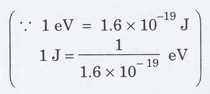
Physics for Electronics Engineering: Unit II: Electrical and Magnetic Properties of Materials : Tag: : Electrical Properties of Materials | Physics for Electronics Engineering - 16 marks Important Questions and Assignment Problems
Physics for Electronics Engineering: Unit II: Electrical and Magnetic Properties of Materials
Under Subject
Physics for Electronics Engineering
PH3254 - Physics II - 2nd Semester - ECE Department - 2021 Regulation | 2nd Semester ECE Dept 2021 Regulation
Related Subjects
Professional English II
HS3251 2nd Semester 2021 Regulation | 2nd Semester Common to all Dept 2021 Regulation
Statistics and Numerical Methods
MA3251 2nd Semester 2021 Regulation M2 Engineering Mathematics 2 | 2nd Semester Common to all Dept 2021 Regulation
Engineering Graphics
GE3251 eg 2nd semester | 2021 Regulation | 2nd Semester Common to all Dept 2021 Regulation
Physics for Electrical Engineering
PH3202 2nd Semester 2021 Regulation | 2nd Semester EEE Dept 2021 Regulation
Basic Civil and Mechanical Engineering
BE3255 2nd Semester 2021 Regulation | 2nd Semester EEE Dept 2021 Regulation
Electric Circuit Analysis
EE3251 2nd Semester 2021 Regulation | 2nd Semester EEE Dept 2021 Regulation
Physics for Electronics Engineering
PH3254 - Physics II - 2nd Semester - ECE Department - 2021 Regulation | 2nd Semester ECE Dept 2021 Regulation
Electrical and Instrumentation Engineering
BE3254 - 2nd Semester - ECE Dept - 2021 Regulation | 2nd Semester ECE Dept 2021 Regulation
Circuit Analysis
EC3251 - 2nd Semester - ECE Dept - 2021 Regulation | 2nd Semester ECE Dept 2021 Regulation
Materials Science
PH3251 2nd semester Mechanical Dept | 2021 Regulation | 2nd Semester Mechanical Dept 2021 Regulation
Basic Electrical and Electronics Engineering
BE3251 2nd semester Mechanical Dept | 2021 Regulation | 2nd Semester Mechanical Dept 2021 Regulation
Physics for Civil Engineering
PH3201 2021 Regulation | 2nd Semester Civil Dept 2021 Regulation
Basic Electrical, Electronics and Instrumentation Engineering
BE3252 2021 Regulation | 2nd Semester Civil Dept 2021 Regulation
Physics for Information Science
PH3256 2nd Semester CSE Dept | 2021 Regulation | 2nd Semester CSE Dept 2021 Regulation
Basic Electrical and Electronics Engineering
BE3251 2nd Semester CSE Dept 2021 | Regulation | 2nd Semester CSE Dept 2021 Regulation
Programming in C
CS3251 2nd Semester CSE Dept 2021 | Regulation | 2nd Semester CSE Dept 2021 Regulation