Electrical and Instrumentation Engineering: Unit I: Transformer
Transformation Ratio
Solved Example Problems
Keeping supply frequency constant, if primary voltage is increased by 10%, magnetizing current will increase by much more than 10%. However, due to saturation, flux density will increase only marginally and so will the eddy current and hysteresis losses.
TRANSFORMATION RATIO (K)
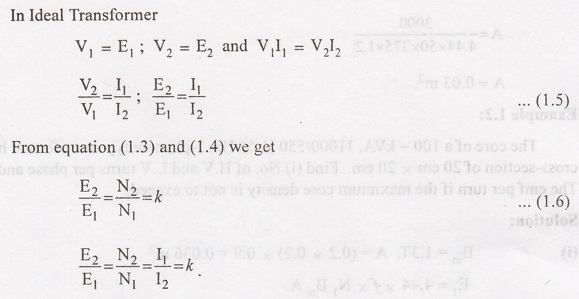
'k' is called
transformation ratio.
If N2
> N1. i.e., k> 1, then transformer is a step up transformer.
If N2
< N1. i.e., k < 1, then transformer is a step down
transformer.

Example 1.1:
The maximum flux
density in the core of a 250/300 V, 50 Hz single phase transformer is 1.2 Wb/m2.
If the emf per turn is 8 volt, determine (i) Primary and Secondary turns, (ii)
Area of the core.
Solution:
(i) E1
= N1 × emf
induced/turn
E1 =
250/8 = 32; N2 = 3000/8 = 375.
(ii) We may use
E2 =
4.44 ƒN2 Bm A

Example 1.2:
The core of a
100 - kVA, 11000/550 V, 50 Hz, 1-ph, core type transformer has a cross-section
of 20 cm x 20 cm. Find (i) No. of H.V and L.V turns per phase and (ii) The emf
per turn if the maximum core density is not to exceed.
Solution:

Keeping supply
frequency constant, if primary voltage is increased by 10%, magnetizing current
will increase by much more than 10%. However, due to saturation, flux density
will increase only marginally and so will the eddy current and hysteresis
losses.
Example 1.3:
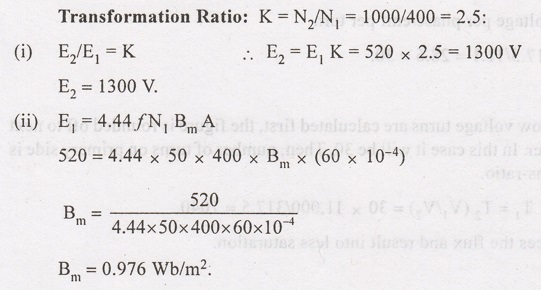
A single phase
transformer has 400 primary and 1000 secondary turns. The net cross sectional
area of the core is 60 cm2. If the primary winding be connected to a
50 Hz supply at 520 V. Calculate (i) the peak value of flux density in the
core, (ii) the voltage induced in the secondary winding.
Solution:
Example 1.4:
The core of a
three phase, 50 Hz, 11000/550 V delta/star, 300 kVA, core type transformer
operates with a flux of 0.05 wb. Find
(i) Number of
H.V and L.V turns per phase.
(ii) emf per
turn.
(iii) Full load
HV and LV phase currents.
Solution: Maximum value of flux has been given as 0.05 wb:
(i) emf per turn = 4.44 f φm =
4.44 × 50 × 0.05 = 11.1 Volts.
(ii) Calculations for number of turns two sides:
Voltage per
phase on delta-connected primary winding = 11,000 V
Voltage per
phase on star connected secondary winding = 550/1.732 = 317.5 Volts.
T1 = Number of
turns of primary, per phase = Voltage per phase/emf per turn = 11,000/11.1 =
991.
T2 = Number of
turns on secondary, per phase = Voltage per phase/emf per turn = 317.5/11.1 =
28.6 = 30.
Note:
Generally, low
voltage turns are calculated first, the figure is rounded off to next higher
even integer. In this case it will be 30. Then, number of turns on primary side
is calculated by turns-ratio.
T1 =
T2 (V1 / V2) = 30 x 11,000/317.5 = 1040.
It will reduces
the flux and result into less saturation.
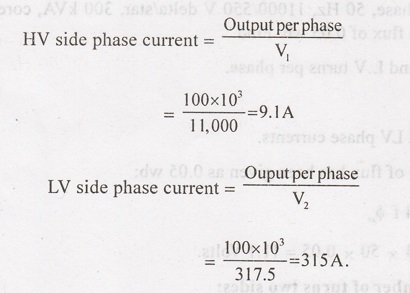
(iii) Full load HV and LV phase currents.
Output per phase
= 300/3 = 100 kVA
Example 1.5:
A single phase
transformer has 500 turns in the primary and 1200 turns in the secondary. The
cross sectional area of the core is 80 sq.cm. If the primary winding is
connected to a 50 Hz supply at 500V, Calculate (i) peak flux density, (ii)
voltage induced in the secondary.
Solution: Emf equation of transformer
E1 =
4.44 f φm N
500 = 4.44 × 50 ×
φm × 500

Example 1.6:
A 25 kVA,
single-phase transformer has 250 turns on the primary and 40 turns on the
secondary winding. The primary is connected to 1500 volt, 50 Hz mains.
Calculate,
(i) Primary and
Secondary currents on full load
(ii) Secondary
emf
(iii) Maximum
flux in the core.
Solution:
(i) V2
= Secondary voltage rating = Secondary emf
V2 /
1500 = 40 / 250, going V2 = 240 volts
(ii) Primary
current = 25,000/1500 = 16.67 A
Secondary
current = 25000/240 = 104.2 A.
(iii) If φm
is the maximum core flux in wb,
1500 = 4.44 x 50
x φm x 250
φm =
0.027 wb (or) 27 m wb.
Electrical and Instrumentation Engineering: Unit I: Transformer : Tag: : Solved Example Problems - Transformation Ratio
Electrical and Instrumentation Engineering: Unit I: Transformer
Under Subject
Electrical and Instrumentation Engineering
BE3254 - 2nd Semester - ECE Dept - 2021 Regulation | 2nd Semester ECE Dept 2021 Regulation
Related Subjects

Professional English II
HS3251 2nd Semester 2021 Regulation | 2nd Semester Common to all Dept 2021 Regulation
Statistics and Numerical Methods
MA3251 2nd Semester 2021 Regulation M2 Engineering Mathematics 2 | 2nd Semester Common to all Dept 2021 Regulation
Engineering Graphics
GE3251 eg 2nd semester | 2021 Regulation | 2nd Semester Common to all Dept 2021 Regulation
Physics for Electrical Engineering
PH3202 2nd Semester 2021 Regulation | 2nd Semester EEE Dept 2021 Regulation
Basic Civil and Mechanical Engineering
BE3255 2nd Semester 2021 Regulation | 2nd Semester EEE Dept 2021 Regulation
Electric Circuit Analysis
EE3251 2nd Semester 2021 Regulation | 2nd Semester EEE Dept 2021 Regulation
Physics for Electronics Engineering
PH3254 - Physics II - 2nd Semester - ECE Department - 2021 Regulation | 2nd Semester ECE Dept 2021 Regulation
Electrical and Instrumentation Engineering
BE3254 - 2nd Semester - ECE Dept - 2021 Regulation | 2nd Semester ECE Dept 2021 Regulation
Circuit Analysis
EC3251 - 2nd Semester - ECE Dept - 2021 Regulation | 2nd Semester ECE Dept 2021 Regulation
Materials Science
PH3251 2nd semester Mechanical Dept | 2021 Regulation | 2nd Semester Mechanical Dept 2021 Regulation
Basic Electrical and Electronics Engineering
BE3251 2nd semester Mechanical Dept | 2021 Regulation | 2nd Semester Mechanical Dept 2021 Regulation
Physics for Civil Engineering
PH3201 2021 Regulation | 2nd Semester Civil Dept 2021 Regulation
Basic Electrical, Electronics and Instrumentation Engineering
BE3252 2021 Regulation | 2nd Semester Civil Dept 2021 Regulation
Physics for Information Science
PH3256 2nd Semester CSE Dept | 2021 Regulation | 2nd Semester CSE Dept 2021 Regulation
Basic Electrical and Electronics Engineering
BE3251 2nd Semester CSE Dept 2021 | Regulation | 2nd Semester CSE Dept 2021 Regulation
Programming in C
CS3251 2nd Semester CSE Dept 2021 | Regulation | 2nd Semester CSE Dept 2021 Regulation