Electrical and Instrumentation Engineering: Unit I: Transformer
Elementary Theory of an Ideal Transformer
An ideal transformer is one which has no losses i.e., its windings have no ohmic resistance, there is no magnetic leakage and hence it does not have I2R and core losses. In other words, an ideal transformer consists of two purely inductive coils wound on a loss-free core.
ELEMENTARY THEORY OF AN IDEAL TRANSFORMER
An
ideal transformer is one which has no losses i.e., its windings have no ohmic
resistance, there is no magnetic leakage and hence it does not have I2R
and core losses. In other words, an ideal transformer consists of two purely
inductive coils wound on a loss-free core. But it is impossible to realize such
a transformer in practice.
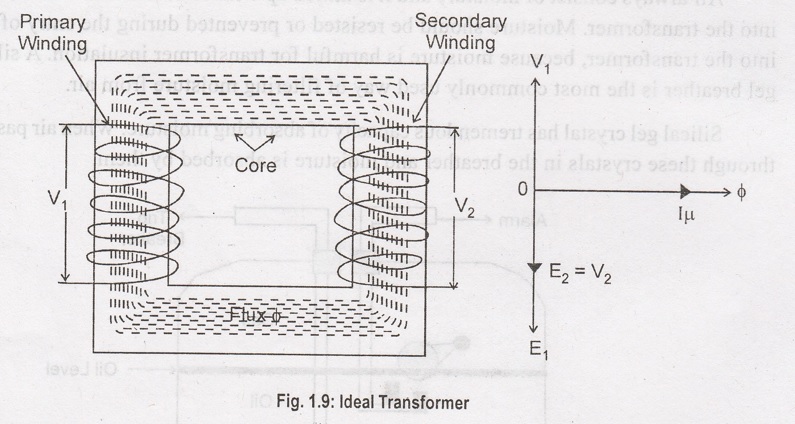
Consider
an ideal transformer in Figure 1.9 whose secondary is open and whose primary is
connected to sinusoidal alternating voltage V1. This potential
difference causes an alternating current to flow in the primary. Primary coil
is purely inductive and secondary is open (no output), so primary draws the
magnetizing current Iµ only. Function of Iµ is to
magnetize the core (i.e.,) the core is act like a magnetic material. It is
small in magnitude and lags V1 by 90°. The magnetizing current Iµ
produces an alternating flux in the core which is proportional to current
(assuming permeability of the magnetic circuit to be constant). Iµ
is in phase with flux φ. The changing flux is linked with the primary and
secondary winding. Due to the alternating flux, a self induced emf is produced
in the primary which is equal and opposite to V1 and donated as E1.
It is called as counter emf or back emf on the primary winding.
Similarly,
an induced emf E2 is produced in the secondary winding, because
alternating flux is also linking with secondary winding. This emf is called as
mutually induced emf. E2 is in opposition to V1 and its
magnitude is proportional to the rate of change of flux and number of secondary
turns.
Electrical and Instrumentation Engineering: Unit I: Transformer : Tag: : - Elementary Theory of an Ideal Transformer
Electrical and Instrumentation Engineering: Unit I: Transformer
Under Subject
Electrical and Instrumentation Engineering
BE3254 - 2nd Semester - ECE Dept - 2021 Regulation | 2nd Semester ECE Dept 2021 Regulation
Related Subjects
Professional English II
HS3251 2nd Semester 2021 Regulation | 2nd Semester Common to all Dept 2021 Regulation
Statistics and Numerical Methods
MA3251 2nd Semester 2021 Regulation M2 Engineering Mathematics 2 | 2nd Semester Common to all Dept 2021 Regulation
Engineering Graphics
GE3251 eg 2nd semester | 2021 Regulation | 2nd Semester Common to all Dept 2021 Regulation
Physics for Electrical Engineering
PH3202 2nd Semester 2021 Regulation | 2nd Semester EEE Dept 2021 Regulation
Basic Civil and Mechanical Engineering
BE3255 2nd Semester 2021 Regulation | 2nd Semester EEE Dept 2021 Regulation
Electric Circuit Analysis
EE3251 2nd Semester 2021 Regulation | 2nd Semester EEE Dept 2021 Regulation
Physics for Electronics Engineering
PH3254 - Physics II - 2nd Semester - ECE Department - 2021 Regulation | 2nd Semester ECE Dept 2021 Regulation
Electrical and Instrumentation Engineering
BE3254 - 2nd Semester - ECE Dept - 2021 Regulation | 2nd Semester ECE Dept 2021 Regulation
Circuit Analysis
EC3251 - 2nd Semester - ECE Dept - 2021 Regulation | 2nd Semester ECE Dept 2021 Regulation
Materials Science
PH3251 2nd semester Mechanical Dept | 2021 Regulation | 2nd Semester Mechanical Dept 2021 Regulation
Basic Electrical and Electronics Engineering
BE3251 2nd semester Mechanical Dept | 2021 Regulation | 2nd Semester Mechanical Dept 2021 Regulation
Physics for Civil Engineering
PH3201 2021 Regulation | 2nd Semester Civil Dept 2021 Regulation
Basic Electrical, Electronics and Instrumentation Engineering
BE3252 2021 Regulation | 2nd Semester Civil Dept 2021 Regulation
Physics for Information Science
PH3256 2nd Semester CSE Dept | 2021 Regulation | 2nd Semester CSE Dept 2021 Regulation
Basic Electrical and Electronics Engineering
BE3251 2nd Semester CSE Dept 2021 | Regulation | 2nd Semester CSE Dept 2021 Regulation
Programming in C
CS3251 2nd Semester CSE Dept 2021 | Regulation | 2nd Semester CSE Dept 2021 Regulation