Signals and Systems: Unit I: Classification of Signals and Systems,,
Problems Based on Static (or) Dynamic System
Problems Based on Static (or) Dynamic System (I) Determine whether the following CT systems are static (or) dynamic. (II) Determine whether the following systems are static (or) dynamic.
Problems
Based on Static (or) Dynamic System
(I) Determine whether the following CT
systems are static (or) dynamic.
1. y(t) = cos[x(t)]
Solution:
Output y(t) depends
upon present input x(t). Hence the system is memory less (or) Static system.
2. y(t) = 20 x(t) + 15
Solution:
Output y(t) depends
upon present input x(t). Hence the given system is memory less (or) static
system.
3. y(t) = e x(t)
Solution:-
Output y(t) depends
upon present input x(t). Hence the given system is memory less (or) static
system.
4. y(t) = x(t+5)+ x2(t)
Solution:
Output y(t) depends
upon the future input x(t + 5). Hence the given system is dynamic system.
5. y(t) = x(t4)
Solution:
If t = 2, y(2) = x(16)
Output y(t) depends
upon future input x(t4). Hence the given system is dynamic system.
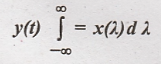
6. 
Solution:
This system requires
memory to store the integration of all earlier terms. Hence the given system is
dynamic system.
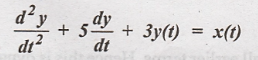
7. 
Solution:
Differentiation makes system dynamic. Hence the given system is dynamic system.
8. y(t) = dx(t)/dt
Solution:
Differentiation makes
system dynamic. Hence the given system is dynamic system.
9. y1(t) =
x(t - 5) + x(5 - t)
Solution:
Output y(t) depends
upon past and future input. Hence the given system is dynamic system.
10. y(t) = et
x(t)
Solution:
Output y(t) depends
upon present input x(t). Hence the given system is memoryless (or) static
system
11. y(t) = x(t) cos
100πt
Solution:
Output y(t) depends
upon present input x(t). Hence the given system is memoryless (or) static
system.
12. y(t) = x(t/2)
Solution:
when t = 2, y(2) = x(1)
Output y(t) depends
upon past input. Hence the given system is dynamic
13. y(t) = x(t+10) + x2(t)
Solution:
Output y(t) depends
upon the future input x(t+10). Hence the given system requires memory to store
the future input. This is dynamic system.
14. y(t) = x(-t)
Solution:
when t = 2, y(2) =
x(−2)
Output y(t) depends
upon past input. Hence the given system is dynamic system.
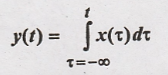
15. 
Solution:
Given system requires
memory to store all earlier terms. Hence this is dynamic system.
(II) Determine whether the following
systems are static (or) dynamic.
1. y(n) = 5x(n) + 8x2(n)
Solution:
Output depends upon
present input only. Hence the given system is static system.
2. y(n) = cos[4πx
(n+1)]
Solution:
Output depends upon
future input x(n+1). Hence the given system is dynamic system.
3. y(n) = log10(|x(n)|)
Solution:
Output depends upon
present input x(n). Hence the given system is static system.
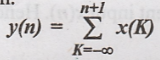
4. 
Solution:
Output y(n) depends
upon the input ranges from x(-∞) to x(n+1). Hence the given system is dynamic
system.
5. y(n) = x(4n)
Solution:
Output y(n) depends
upon future input. Hence the given system is dynamic system.
6. y(n) = n x(n)
Solution:
Output y(n) depends
upon present input x(n). Hence the given system is static system.
7. y(n) = x(n) cos (ω0n)
Solution:
Output y(n) depends
upon present input x(n). Hence the given system is static system.
8. y(n) = x(n3)
Solution:
Output y(n) depends
upon future input. Hence the given system is dynamic system.
9. y(n) = x(n) + 5u
(n+5)
Solution:
Output y(n) depends
upon present input x(n). Hence the given system is static system.
10. y(n) = sgn [x(n)]
Solution:
Output y(n) depends
upon present input x(n). Hence the given system is static system.
11. y(n) = 2x(2n)
Solution:
For n = 2, y(2) = 2x(4)
System requires memory
to store the future input. Hence the given system is dynamic system.
12. y(n) = sin x(n)
Solution:
Output y(n) depends
upon present input x(n). Hence the given system is static system.
13. y(n) = ax(n)
Solution:
Output y(n) of the
given system depends upon present input x(n). Hence the given system is static
system.
14. y(n) = x(2n)
Solution:
Example: when n = 3,
y(3) = x(6).
Output y(n) depends
upon future input. Hence the given system is dynamic system.
15. y(n) = x(n) +
nx(n+1)
Solution:
Output y(n) depends
upon future input x(n+1). Hence the given system is dynamic system.
16. y(n) = n x(n) + bx2(n)
Solution:
Output y(n) depends
upon present input x(n) alone. Hence the given system is static system.
17. y(n)=|x(n)|
Solution:
Output y(n) depends
upon present input x(n). Hence the given system is static system.
18. y(n) = x(n) + x2(n)
Solution:
Output y(n) depends
upon present input. Hence the given system is static system.
19. y(n) = x(n) u(n)
Solution:
Output y(n) depends
upon present input x(n). Hence the given system is static system.
Signals and Systems: Unit I: Classification of Signals and Systems,, : Tag: : - Problems Based on Static (or) Dynamic System
Signals and Systems: Unit I: Classification of Signals and Systems,,
Under Subject

Signals and Systems
EC3354 - 3rd Semester - ECE Dept - 2021 Regulation | 3rd Semester ECE Dept 2021 Regulation
Related Subjects
Random Process and Linear Algebra
MA3355 - M3 - 3rd Semester - ECE Dept - 2021 Regulation | 3rd Semester ECE Dept 2021 Regulation
Signals and Systems
EC3354 - 3rd Semester - ECE Dept - 2021 Regulation | 3rd Semester ECE Dept 2021 Regulation
Electronic Devices and Circuits
EC3353 - EDC - 3rd Semester - ECE Dept - 2021 Regulation | 3rd Semester ECE Dept 2021 Regulation
Control Systems
EC3351 - 3rd Semester - ECE Dept - 2021 Regulation | 3rd Semester ECE Dept 2021 Regulation
Digital Systems Design
EC3352 - DSD - 3rd Semester - ECE Dept - 2021 Regulation | 3rd Semester ECE Dept 2021 Regulation