Signals and Systems: Unit I: Classification of Signals and Systems,,
Classification of Continuous and Discrete Time Signals
Continuous time and discrete time signals are classified according to their properties as follows. 1. Periodic and aperiodic signals 2. Energy and power signals 3. Deterministic and random signals.
CLASSIFICATION
OF CONTINUOUS TIME AND DISCRETE TIME SIGNALS
Continuous time and
discrete time signals are classified according to their properties as follows.
1. Periodic and
aperiodic signals
2. Energy and power
signals
3. Deterministic and
random signals.
Periodic and Aperiodic (Non-Periodic) Signals (CT & DT)
i. A signal is said to
be periodic, if it repeats at regular interval of time.
ii. A signal is said to
be non periodic (Aperiodic) if it does not repeats at regular interval of time.
Condition for periodic signal and Aperiodic signal:
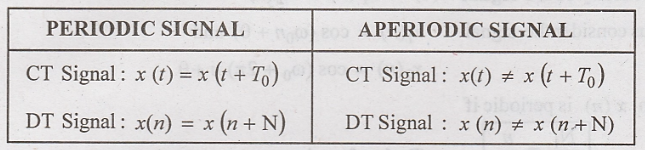
T0 > 0, ⇒ period of the signal.
: f0 = 1/T0 → frequency of the signal.
N ⇒ period of x(n) in
samples.
Periodicity of the
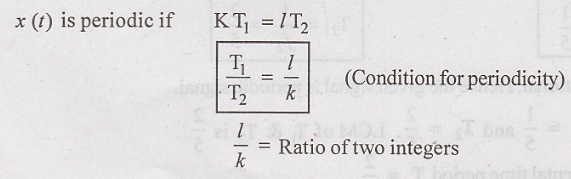
Signal x(t) = x1(t) + x2(t)
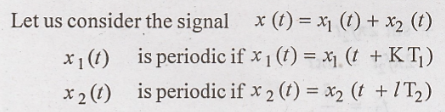
Here K and l are
integers
Periodicity of DT signal x(n)
Let us consider the
signal 
x(n) is periodic if
x(n) = x(n + N)
Replace n by n + N in.
(1)
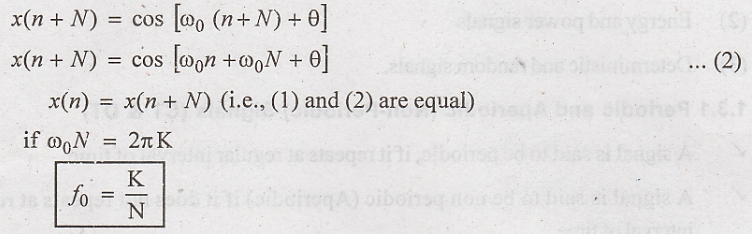
Here K is integer.
Periodicity of DT
signal x(n) = x1(n) + x2(n)
Let us consider the
signal
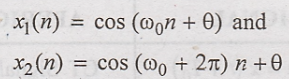
Then x (n) is periodic
if
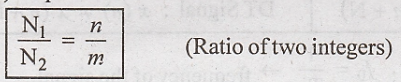
Examples on Periodicity (Continuous Time Signal)
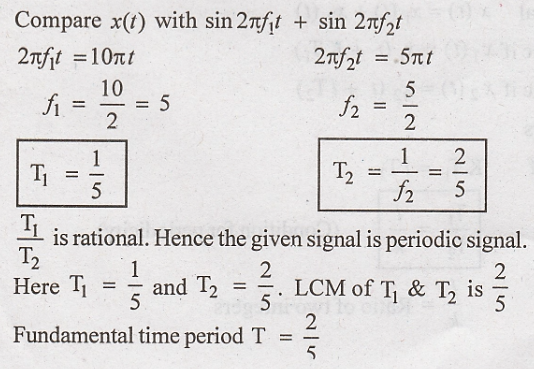
1. Find the periodicity
of x(t) = sin 10 π t + sin 5 π t
Solution:
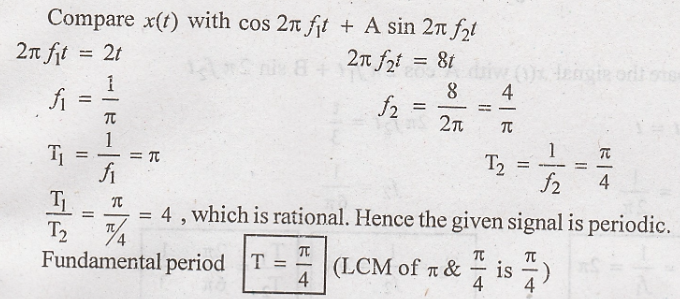
2. Find the periodicity
of x(t)
Solution:
3. Determine the
periodicity of following signal. If periodic obtain its fundamental period.
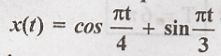
Solution:
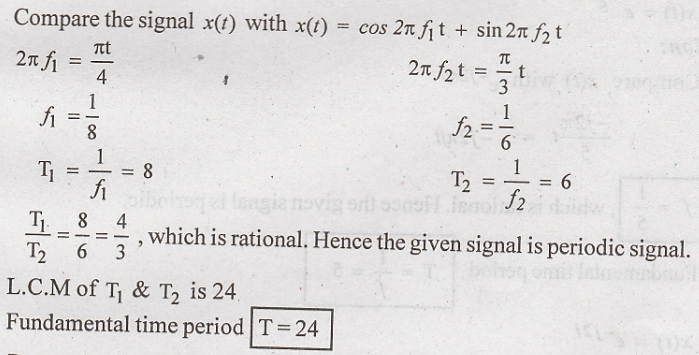
4. Determine whether
the following signals are periodic or not. If periodic determine the
fundamental period.
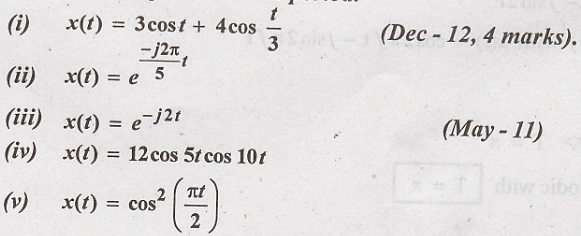

Solution
:
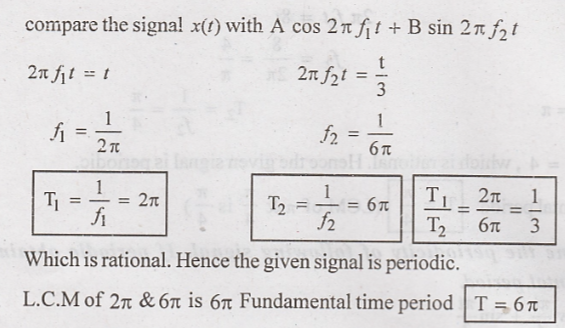
(ii) 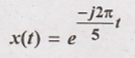
Solution
:

(iii) 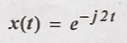
Solution :
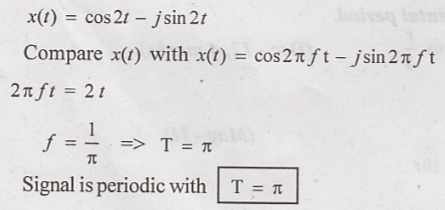
(iv) 
Solution
:
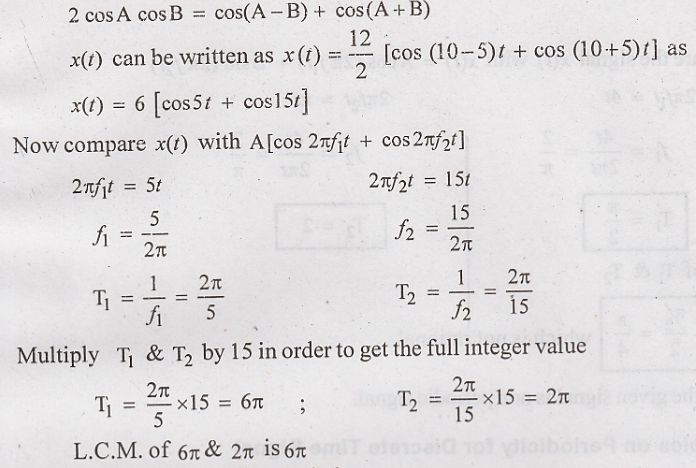
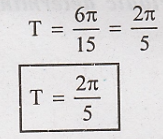
Hence the fundamental
time period
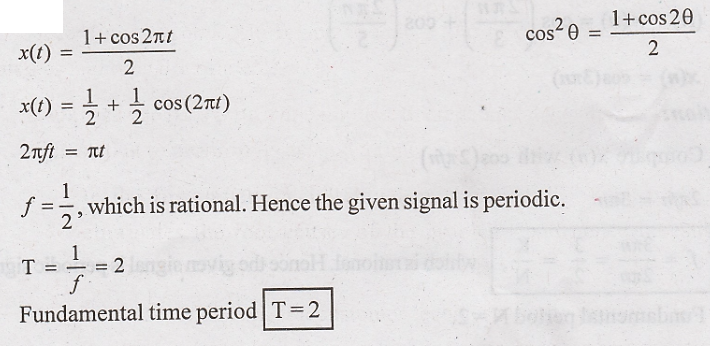
(v) 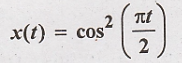
Solution
:
5) Determine the
periodicity of the following signal x(t) = 5 cos(4t) + sin(πt)
Solution:
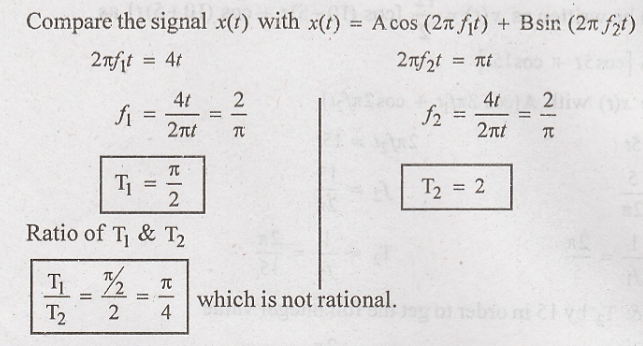
Hence the given signal
is non periodic signal.
Examples on Periodicity for Discrete Time Signal
(1) Check the
periodicity of following signal. If periodic determine its fundamental period.
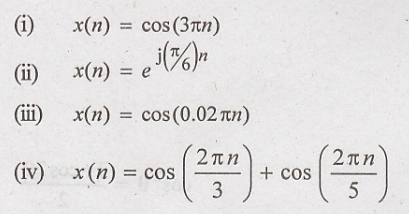

Solution:
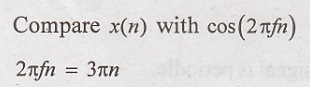
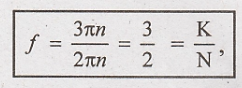 which is
rational. Hence the given signal is periodic signal.
which is
rational. Hence the given signal is periodic signal.
Fundamental period N = 2.
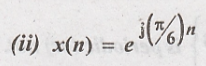
Solution
:
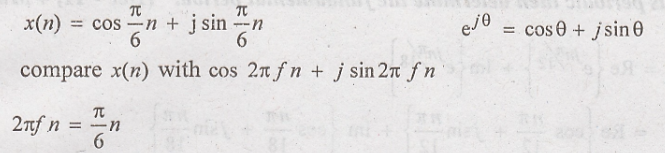 ,
,
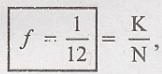 which is
rational. Hence the given signal periodic signal with period N = 12
which is
rational. Hence the given signal periodic signal with period N = 12

Solution
:
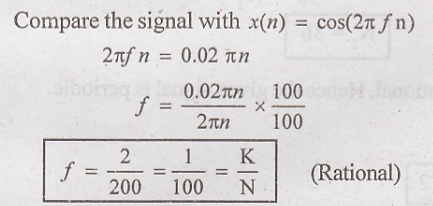
Hence the given signal
is periodic signal with period N = 100

Solution
:
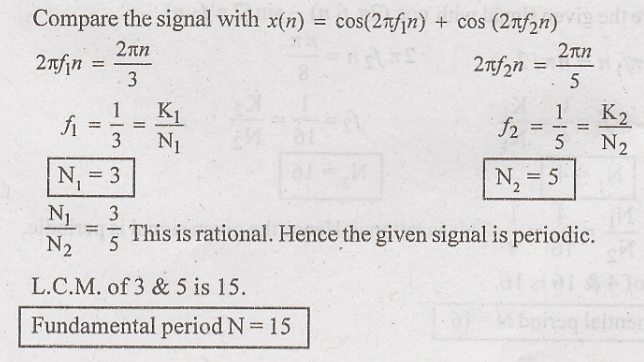

Solution
:


Solution
:

4. Determine whether
the following signal is periodic (or) not. If periodic find the fundamental
period.
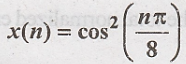
Solution:
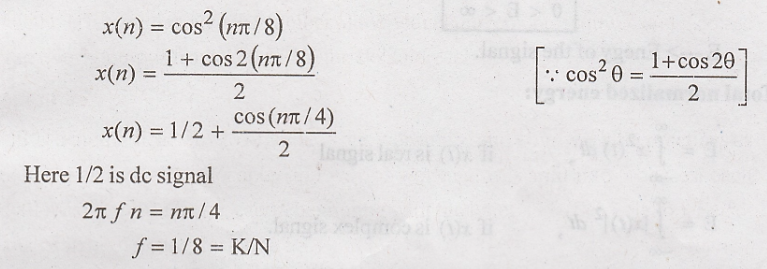
This is rational. Hence
the given signal is periodic signal with fundamental period N = 8.
5. Determine whether
the following signal is periodic (or) not. x(n) = cos2n.
Solution:
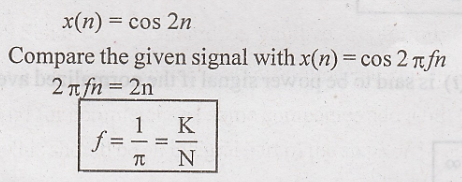
This is not rational.
Hence the given signal is nonperiodic signal.
6. Determine whether
the following signal is periodic (or) not. 
Solution :
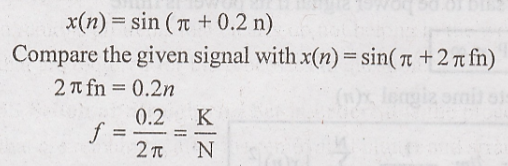
This is not rational. Hence the given signal is nonperiodic signal.
Signals and Systems: Unit I: Classification of Signals and Systems,, : Tag: : - Classification of Continuous and Discrete Time Signals
Signals and Systems: Unit I: Classification of Signals and Systems,,
Under Subject

Signals and Systems
EC3354 - 3rd Semester - ECE Dept - 2021 Regulation | 3rd Semester ECE Dept 2021 Regulation
Related Subjects
Random Process and Linear Algebra
MA3355 - M3 - 3rd Semester - ECE Dept - 2021 Regulation | 3rd Semester ECE Dept 2021 Regulation
Signals and Systems
EC3354 - 3rd Semester - ECE Dept - 2021 Regulation | 3rd Semester ECE Dept 2021 Regulation
Electronic Devices and Circuits
EC3353 - EDC - 3rd Semester - ECE Dept - 2021 Regulation | 3rd Semester ECE Dept 2021 Regulation
Control Systems
EC3351 - 3rd Semester - ECE Dept - 2021 Regulation | 3rd Semester ECE Dept 2021 Regulation
Digital Systems Design
EC3352 - DSD - 3rd Semester - ECE Dept - 2021 Regulation | 3rd Semester ECE Dept 2021 Regulation