Signals and Systems: Unit I: Classification of Signals and Systems,,
Examples on Stable and Unstable System
Examples on stable and unstable system. Determine whether the following systems are stable (or) unstable.
Examples on stable and unstable system
Determine whether the following systems
are stable (or) unstable.
1. y(t) = x(-t)
Solution:
As long as x(t) is
bounded, y(t) also bouned. Hence the given system is stable.
2. T[x(n)] = a x(n) + b
Solution:
T[x(n)] = y(n)
Since y(n) is bounded
as long as x(n) is bounded, given system is stable.
3. y(t) = cos[x(t)]
Solution:
Maximum and minimum
value of cosine function is +1 and -1. Hence output y(t) is bounded for bounded
input and the given system is stable.
4. y(t) = e t x(t)
Solution:
For bounded input, y(t)
→ ∞ as t → ∞. Hence the given system is unstable.
5. y(n) = n x(n)
Solution:
For bounded input, y(n)
→ ∞ as n → ∞. Hence the given system is unstable.
6. y(t) = x(t) cos 100
πt
Solution:
As long as input x(t)
is bounded, y(t) also bounded. Hence the given system is stable.
7. y(n) = x(n) +
nx(n+1)
Solution:
For bounded input y(n)
→ ∞ as n → ∞. Output is unbounded for bounded input. Hence the given system is
unstable.
8. y(t) = x(-t)
Solution:
As long as x(t) is
bounded, y(t) is bounded. Hence the given system is stable.
9. y(t) = x(t + 10) + x2(t)
Solution:
Since y(t) is bounded
as long as x(t) is bounded, given is stable.
10. y(t) = 10 x(t) + 5
Solution:
Since y(t) is bounded
as long as x(t) is bounded, given system is stable.
11. y(n) = sin [x(n)] /
x(n)
Solution:
When x(n) → 0, y(n) =
sin 0 / 0 = 1, by L Hospitals rule. Hence the given system is stable.
12. y(n) = x(n)
Solution:
Since y(n) is bounded
as long as x(n) is bounded, given system is stable.
13. y(n) = |x(n)|
Solution:
As long as x(n) is
bounded, its magnitude and y(n) is bounded. Hence the given system is stable.
14. y(n) = log10x(n)
Solution:
If x(n) = 0, y(n) = ∞.
When x(n) is bounded y(n) is unbounded. Hence the given system is unstable.
15. T[x(n)] = ex(n)
Solution:
T[x(n)] = y(n)
As long as x(n) is
bounded y(n) also bounded. Hence the given system is stable.
16. y(n) = ax(n)
Solution:
As long as x(n) is
bounded y(n) also bounded. Hence the given system is stable.
17. y(n) = x(n) u(n)
Solution:
As long as x(n) is
bounded y(n) also bounded. Hence the given system is stable.
18. y(t) = x(t) cos(100
πt)
Solution:
Maximum value of cosine
function is 1. Bounded value of x(t) produces bounded output. Hence the given
system is stable.
19. 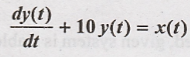
Solution:
As long as x(t) is
bounded, y(t) is bounded. Hence the given system is stable.
20. y(n) = 2x(2n)
Solution
:
Output is double for
any bounded input. Hence the given system is stable.
21. 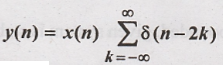
Solution:
As long as x(n) is
bounded, y(n) is bounded. Hence the given system is stable.
22. y(n) = sgn[x(n)]
Solution:
Since y(n) is bounded
as long as x(n) is bounded, given system is stable.
23. y(t) = x(t2)
Solution:
As long as x(t) is
bounded, y(t) also bounded. Hence the given system is stable.
Signals and Systems: Unit I: Classification of Signals and Systems,, : Tag: : - Examples on Stable and Unstable System
Signals and Systems: Unit I: Classification of Signals and Systems,,
Under Subject

Signals and Systems
EC3354 - 3rd Semester - ECE Dept - 2021 Regulation | 3rd Semester ECE Dept 2021 Regulation
Related Subjects
Random Process and Linear Algebra
MA3355 - M3 - 3rd Semester - ECE Dept - 2021 Regulation | 3rd Semester ECE Dept 2021 Regulation
Signals and Systems
EC3354 - 3rd Semester - ECE Dept - 2021 Regulation | 3rd Semester ECE Dept 2021 Regulation

Electronic Devices and Circuits
EC3353 - EDC - 3rd Semester - ECE Dept - 2021 Regulation | 3rd Semester ECE Dept 2021 Regulation
Control Systems
EC3351 - 3rd Semester - ECE Dept - 2021 Regulation | 3rd Semester ECE Dept 2021 Regulation
Digital Systems Design
EC3352 - DSD - 3rd Semester - ECE Dept - 2021 Regulation | 3rd Semester ECE Dept 2021 Regulation