Physics for Electronics Engineering: Unit IV: Optical Properties of Materials
Solar Cell
Construction, Working Principle, VI Characteristics, Efficiency, Energy Band diagram, Advantages, Disadvantages, Uses
It is a P-N junction diode which converts solar energy (light energy) into electrical energy.
SOLAR CELL
It is a P-N junction diode which converts
solar energy (light energy) into electrical energy.
Common
materials for solar cells include silicon (Si), Gallium Aresnide (GaAs), Indium
Arsenide (InAs) and Cadmium Arsenide (CdAs). The most common is silicon. mon is
silicon
For
silicon, the band gap (the energy necessary to transfer an electron from upper
valence level to conduction band) is 1.12 eV.
Construction
It consists of P-N junction diode made of Silicon (fig. 4.16 (a)). The P-N diode is packed in a can with glass window on top such that light may fall upon P and N type materials. The symbol of the solar cell is shown in fig. 4.16 (b). The inward arrow indicates the incoming light.
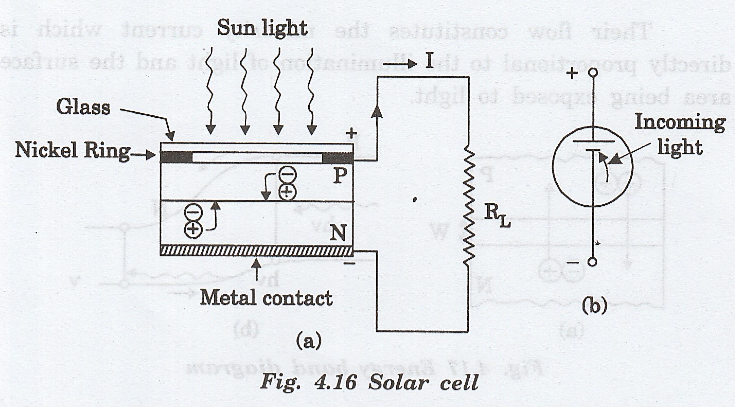
The
thickness of the P-region is kept very small. Therefore, electrons generated in
P region can diffuse to the junction before recombination takes place.
The
thickness of N-region is also kept small to allow holes generated near the
surface to diffuse to the junction before they recombine.
A
nickel ring is provided around the P-layer which acts as the positive output
terminal. A metal contact at the bottom serves as the negative output terminal.
Working
When
light radiation from sun falls on the P-N junction diode, the photon energy is
sufficient to break the covalent-bond and produce electron-hole pair. Thus,
electron-hole pairs are generated in both P and N sides of the junction.
These
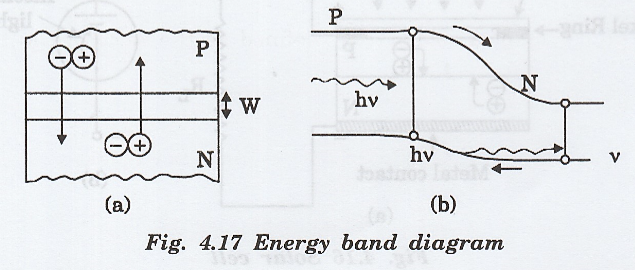
electrons and holes reach the depletion region by diffusion (fig.4.17 (a)) and
they are separated by the strong barrier electrical field existing there.
The minority carrier electrons in the P-side cross the barrier potential to reach N-side and the holes in N-side move to the P-side (fig. 4.17 (b)).
Their
flow constitutes the minority current which is directly proportional to the
illumination of light and the surface area being exposed to light.
The
electrons and holes are accumulated on the two sides of the junction. This
leads to an open circuit voltage Voc which is a function of
illumination.
The
open-circuit voltage produced for a silicon solar cell is typically 0.6 volt
and the short-circuit current is about 40 mA/cm in bright noon day sun light.
V
- I Characteristics
The
V-I characteristics of the solar cell, corresponding to different levels of
illumination is shown in fig.4.18.
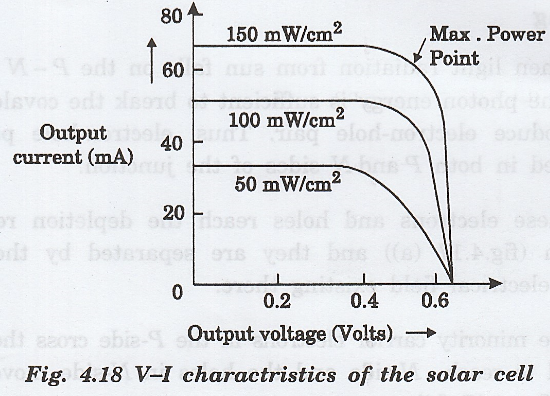
The
maximum power output is obtained when the solar cell is opened at the knee of
the curve.
Advantages
1.
The solar cell operates with fair efficiency.
2.
It has unlimited life.
3.
It can be mass produced.
4.
It has a high power capacity per weight.
5.
Its size is small and compact.
Disadvantages
Solar
energy is not available round the clock. It cannot be obtained during night
time.
Uses
i.
Solar cells are used in satellites and space vehicles to supply power to
electronic and other equipments and to charge storage batteries.
ii.
They are used to give power to the calculators and watches.
iii.
They are used to provide commercial electricity.
Physics for Electronics Engineering: Unit IV: Optical Properties of Materials : Tag: : Construction, Working Principle, VI Characteristics, Efficiency, Energy Band diagram, Advantages, Disadvantages, Uses - Solar Cell
Physics for Electronics Engineering: Unit IV: Optical Properties of Materials
Under Subject
Physics for Electronics Engineering
PH3254 - Physics II - 2nd Semester - ECE Department - 2021 Regulation | 2nd Semester ECE Dept 2021 Regulation
Related Subjects

Professional English II
HS3251 2nd Semester 2021 Regulation | 2nd Semester Common to all Dept 2021 Regulation
Statistics and Numerical Methods
MA3251 2nd Semester 2021 Regulation M2 Engineering Mathematics 2 | 2nd Semester Common to all Dept 2021 Regulation
Engineering Graphics
GE3251 eg 2nd semester | 2021 Regulation | 2nd Semester Common to all Dept 2021 Regulation
Physics for Electrical Engineering
PH3202 2nd Semester 2021 Regulation | 2nd Semester EEE Dept 2021 Regulation
Basic Civil and Mechanical Engineering
BE3255 2nd Semester 2021 Regulation | 2nd Semester EEE Dept 2021 Regulation
Electric Circuit Analysis
EE3251 2nd Semester 2021 Regulation | 2nd Semester EEE Dept 2021 Regulation
Physics for Electronics Engineering
PH3254 - Physics II - 2nd Semester - ECE Department - 2021 Regulation | 2nd Semester ECE Dept 2021 Regulation
Electrical and Instrumentation Engineering
BE3254 - 2nd Semester - ECE Dept - 2021 Regulation | 2nd Semester ECE Dept 2021 Regulation
Circuit Analysis
EC3251 - 2nd Semester - ECE Dept - 2021 Regulation | 2nd Semester ECE Dept 2021 Regulation
Materials Science
PH3251 2nd semester Mechanical Dept | 2021 Regulation | 2nd Semester Mechanical Dept 2021 Regulation
Basic Electrical and Electronics Engineering
BE3251 2nd semester Mechanical Dept | 2021 Regulation | 2nd Semester Mechanical Dept 2021 Regulation
Physics for Civil Engineering
PH3201 2021 Regulation | 2nd Semester Civil Dept 2021 Regulation
Basic Electrical, Electronics and Instrumentation Engineering
BE3252 2021 Regulation | 2nd Semester Civil Dept 2021 Regulation
Physics for Information Science
PH3256 2nd Semester CSE Dept | 2021 Regulation | 2nd Semester CSE Dept 2021 Regulation
Basic Electrical and Electronics Engineering
BE3251 2nd Semester CSE Dept 2021 | Regulation | 2nd Semester CSE Dept 2021 Regulation
Programming in C
CS3251 2nd Semester CSE Dept 2021 | Regulation | 2nd Semester CSE Dept 2021 Regulation