Electrical and Instrumentation Engineering: Unit III: AC Rotating Machines
Types of Single Phase Induction Motor
with their Advantages, Disadvantages, Applications
The single phase induction motors can be classified according to the phase difference produced between the currents in the main and auxiliary windings. The types are: (1) Split-phase motors (2) Capacitor-start motors (3) Capacitor-start capacitor run motors (4) Shaded-pole motors.
Types of Single Phase Induction Motor
The
single phase induction motors can be classified according to the phase
difference produced between the currents in the main and auxiliary windings.
The
types are:
(1)
Split-phase motors.
(2)
Capacitor-start motors.
(3)
Capacitor-start capacitor run motors.
(4)
Shaded-pole motors.
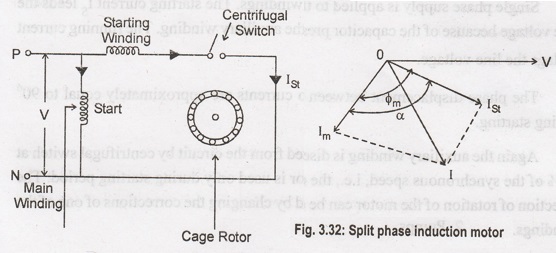
Split-Phase Motors:
It
consists of two stator windings. One is the main winding or running winding and
another is the auxiliary or starting winding. These two windings axis are
displaced by 90 electrical degrees. The auxiliary winding has high resistance
and low reactance and main winding has low resistance and high reactance. Ir
is the current flowing through the starting winding. The auxiliary winding is
only used for starting period. When the motor speed is about 75% of synchronous
speed, the auxiliary winding is disconnected from the circuit. This is done by
connected a centrifugal switch in the auxiliary circuiting. After this, motor
runs only because of main winding.

The
starting torque of the motor can be increased by connecting a resistance in
series with the auxiliary winding. Split-phase induction motor is also called
as resistance start induction motor. Applications are fans, blowers, washing
machines.
Capacitor Start Induction Motor:
Here,
a capacitor is connected in series with the auxiliary (or) starting winding. It
is also used to get higher starting torque.
Single
phase supply is applied to the two windings. The starting current IS
leads the line voltage because of the capacitor present in the auxiliary
winding. The running current Ir lags the line voltage.
The
phase displacement between the two currents are approximately equal to 90°
during starting.
Again
the auxiliary winding is disconnected from the circuit by centrifugal switch at
75% of the synchronous speed, i.e., the capacitor is used only during starting
period. The direction of rotation of the motor can be changed by changing the
corrections of one of the windings.
Applications:
1.
Compressors,
2.
Pumps,
3.
Conveyors,
4.
Washing machine,
5.
Refrigerators.


Capacitor-Start Capacitor-Run Motors:
Here
two capacitors are used one capacitor is used for starting purpose and another
capacitor is used for running purpose. In this motor, we can get high starting
torque, because of two capacitors.
The
value of the starting capacitor is large and the value of running capacitor is
less. The running capacitor is permanently connected in series with auxiliary
winding. When the motor speed picks upto 75% of synchronous speed, the
centrifugal switch is opened and the starting capacitor is disconnected from
the circuit.
The
starting capacitor is used for developing high starting torque and capacitor
Cis used to improve the power factor.
Applications:
It
is mainly used for low noise and high starting torque applications, such as:
1.
Compressors,
2.
Pumps,
3.
Conveyors,
4.
Refrigerators.

Shaded-Pole Single Phase Motor

In
these type of motors, the splitting of phases is done by Induction. These type
of motors will have salient (or) projecting poles stator and a squirrel cage
rotor. A 4-pole stator with the stator poles connected in series. Those poles
will have a slot cut across the laminations approximately one-third distance
from one edge. A short is called as shaded circuited copper coil called as
shading coil is inserted into the slotted portion. This part is called unshaded
part.
Now,
when a alternating current is passed through the stator, the axis of the pole
shifts from unshaded part to the shaded part for the positive half cycle of the
exciting current. This seems to be equivalent to a physical movement of the
pole. Hence this magnetic field will crosses the air-gap and cuts the short
circuited rotor. Hence the rotor starts rotating in the directions of this
shift i.e., from unshaded part to the shaded part.

The
motor starts due to the production of starting torque. This starting torque is
low which is about 40 to 50% of the full load torque shaded motors are
commercially available in vary small sizes from 3 W to 125 W. Due to the
absence of centrifugal switch and capacitors its construction is simple and small.
Advantages:
(i)
Simple in construction
(ii)
Reliable and cheap
(iii)
Compact size.
Disadvantages:
(i)
Low starting torque
(ii)
Carry little overload capacity
(iii)
Low efficiency (5% to 35%).
Applications:
Used
in small toys, hair dryers, ventilators, clock, etc.
Electrical and Instrumentation Engineering: Unit III: AC Rotating Machines : Tag: : with their Advantages, Disadvantages, Applications - Types of Single Phase Induction Motor
Electrical and Instrumentation Engineering: Unit III: AC Rotating Machines
Under Subject
Electrical and Instrumentation Engineering
BE3254 - 2nd Semester - ECE Dept - 2021 Regulation | 2nd Semester ECE Dept 2021 Regulation
Related Subjects
Professional English II
HS3251 2nd Semester 2021 Regulation | 2nd Semester Common to all Dept 2021 Regulation
Statistics and Numerical Methods
MA3251 2nd Semester 2021 Regulation M2 Engineering Mathematics 2 | 2nd Semester Common to all Dept 2021 Regulation
Engineering Graphics
GE3251 eg 2nd semester | 2021 Regulation | 2nd Semester Common to all Dept 2021 Regulation
Physics for Electrical Engineering
PH3202 2nd Semester 2021 Regulation | 2nd Semester EEE Dept 2021 Regulation
Basic Civil and Mechanical Engineering
BE3255 2nd Semester 2021 Regulation | 2nd Semester EEE Dept 2021 Regulation
Electric Circuit Analysis
EE3251 2nd Semester 2021 Regulation | 2nd Semester EEE Dept 2021 Regulation
Physics for Electronics Engineering
PH3254 - Physics II - 2nd Semester - ECE Department - 2021 Regulation | 2nd Semester ECE Dept 2021 Regulation
Electrical and Instrumentation Engineering
BE3254 - 2nd Semester - ECE Dept - 2021 Regulation | 2nd Semester ECE Dept 2021 Regulation
Circuit Analysis
EC3251 - 2nd Semester - ECE Dept - 2021 Regulation | 2nd Semester ECE Dept 2021 Regulation

Materials Science
PH3251 2nd semester Mechanical Dept | 2021 Regulation | 2nd Semester Mechanical Dept 2021 Regulation
Basic Electrical and Electronics Engineering
BE3251 2nd semester Mechanical Dept | 2021 Regulation | 2nd Semester Mechanical Dept 2021 Regulation
Physics for Civil Engineering
PH3201 2021 Regulation | 2nd Semester Civil Dept 2021 Regulation
Basic Electrical, Electronics and Instrumentation Engineering
BE3252 2021 Regulation | 2nd Semester Civil Dept 2021 Regulation

Physics for Information Science
PH3256 2nd Semester CSE Dept | 2021 Regulation | 2nd Semester CSE Dept 2021 Regulation
Basic Electrical and Electronics Engineering
BE3251 2nd Semester CSE Dept 2021 | Regulation | 2nd Semester CSE Dept 2021 Regulation
Programming in C
CS3251 2nd Semester CSE Dept 2021 | Regulation | 2nd Semester CSE Dept 2021 Regulation