Physics for Electronics Engineering: Unit V: Nano Devices
Spintronics Devices and Applications
Principle, Spin diagram, Advantages
Conventional electronic devices rely on the transport of electrical charge carriers - electrons. The 'spin' of the electron can be used rather than its charge to create a remarkable new generation of 'spintronic' devices. These are smaller, more versatile and more robust than those currently making up silicon chips and circuit elements
SPINTRONICS DEVICES AND APPLICATIONS
Conventional
electronic devices rely on the transport of electrical charge carriers - electrons.
The 'spin' of the electron can be used rather than its charge to create a remarkable new generation of 'spintronic' devices. These are smaller, more versatile and more robust than those currently making up silicon chips and circuit elements.
It
is a field of a nanotechnology that deals with spin dependent properties of electrons
and its implication in the device applications.
Spintronics
is the abbreviation of spin transport electronics, also known as spin electronics.
Magneto electronics, Spin Electronics and Spintronics are different name for
the use of electrons' spins (not just their electrical charge) in information circuits.
Principle
All
spintronic devices act according to the simple scheme.
1.
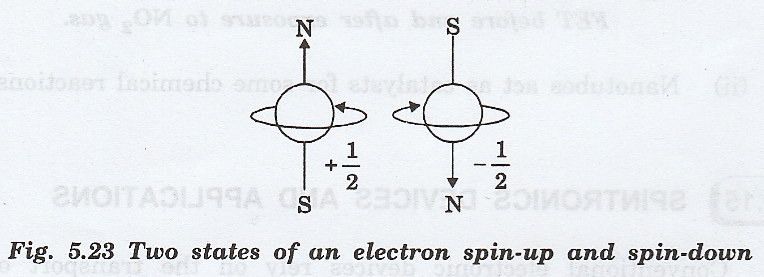
Information is stored (written) into spins as a particular spin orientation (up
or down). (Fig. 5.23)
2.
The spins, being associated to mobile electrons, carry the information along a wire.
3.
The information is read at a terminal.
Spin
orientation of conduction electrons survives for a relatively long time (nanoseconds,
compared to tens of femtoseconds during which electron momentum decays).
This
makes spintronic devices particularly attractive for memory storage storage and
magnetic sensor applications, and potentially for quantum computing.
The electron spin will represent a bit (called qubit) of information in quantum computing.
Since
the advent of spintronics our view of future electronic devices and functionalities
have significantly changed.
Spintronics
links the conventional microelectronic functionality of semiconductor building
blocks to the nonvolatility of magnetic building blocks.
Spintronics devices
Spin valve
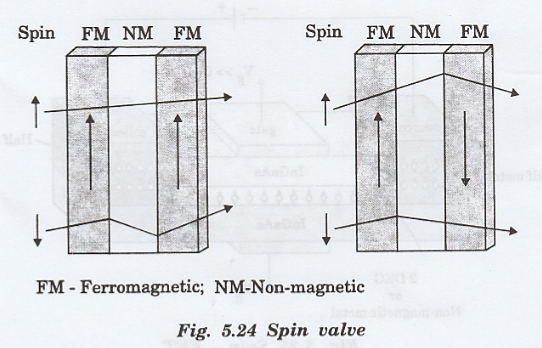
A
spin valve is a device which provides the Giant Magneto resistive effect. The
device can be made to be highly resistive or highly conductive depending on the
direction of the applied magnetic fields in the conducting layers. This
technology offers very fast switching speeds and reduced power consumption.
(Fig. 5.24)
Spin - FET
A spin based Field Effect Transistor ie., SPIN-FET structure is shown in fig 5.25.
For
functioning of this device, first the spins have to be injected from source
into the non-magnetic layer and then transmitted to the collector.
The
injected spins which are transmitted through this layer start precessing as illustrated
in fig 5.25, before they reach the collector due to the spin-orbit coupling
effect.
Hence,
the net spin polarization is reduced. In order to solve this problem an electrical
field is applied perpendicularly to the plane of the film by depositing a gate
electrode on the top to reduce the spin-orbit coupling effect.
In
fig. 5.25 Vg is the gate voltage. When Vg is zero the injected spins which are transmitted
through the 2DEG (2-Dimensional Electron Gas) layer starts precessing before
they reach the collector, thereby reducing the net spin polarization.
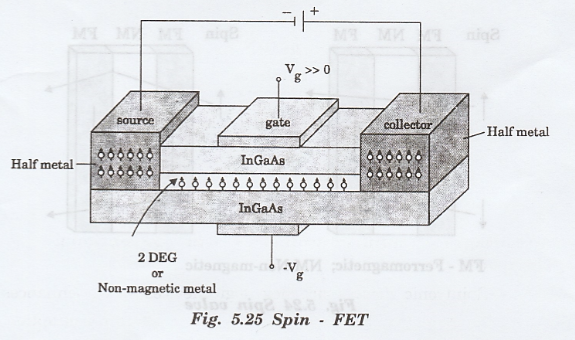
When
Vg >> 0 the precession of the electrons is controlled with
electrical filed thereby allowing the spins to reach at the collector with the
same polarization.
By controlling the gate voltage and polarity, the current in the collector can be modulated just like the MOSFET of the conventional electronics.
Spin LED
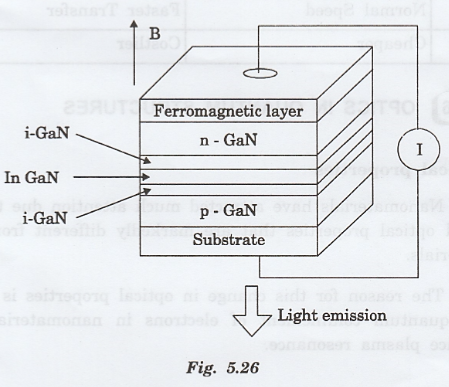
In
spin LEDs the emitted light possess a polarization dependent on the spin polarization
of the charge carriers involved in the recombination. Due to this
spin-dependent polarization, a device such as a spin LED can be used to produce
light of a specific polarization. Additionally, spin LEDs can be used in the
study and development of other spintronics devices. (Fig. 5.26)
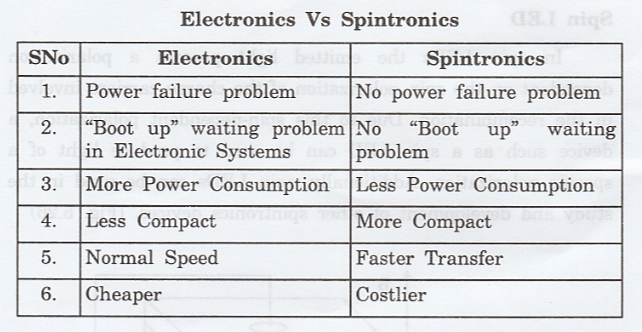
Advantages of spintronic devices
over conventionale electronic devices
i.
Spintronic devices are new logic devices which enhances allud to functionality,
high speed and reduced power consumption.
ii. Also ultimate miniaturization is possible with less power dissipation
Physics for Electronics Engineering: Unit V: Nano Devices : Tag: : Principle, Spin diagram, Advantages - Spintronics Devices and Applications
Physics for Electronics Engineering: Unit V: Nano Devices
Under Subject
Physics for Electronics Engineering
PH3254 - Physics II - 2nd Semester - ECE Department - 2021 Regulation | 2nd Semester ECE Dept 2021 Regulation
Related Subjects

Professional English II
HS3251 2nd Semester 2021 Regulation | 2nd Semester Common to all Dept 2021 Regulation
Statistics and Numerical Methods
MA3251 2nd Semester 2021 Regulation M2 Engineering Mathematics 2 | 2nd Semester Common to all Dept 2021 Regulation
Engineering Graphics
GE3251 eg 2nd semester | 2021 Regulation | 2nd Semester Common to all Dept 2021 Regulation
Physics for Electrical Engineering
PH3202 2nd Semester 2021 Regulation | 2nd Semester EEE Dept 2021 Regulation
Basic Civil and Mechanical Engineering
BE3255 2nd Semester 2021 Regulation | 2nd Semester EEE Dept 2021 Regulation
Electric Circuit Analysis
EE3251 2nd Semester 2021 Regulation | 2nd Semester EEE Dept 2021 Regulation
Physics for Electronics Engineering
PH3254 - Physics II - 2nd Semester - ECE Department - 2021 Regulation | 2nd Semester ECE Dept 2021 Regulation
Electrical and Instrumentation Engineering
BE3254 - 2nd Semester - ECE Dept - 2021 Regulation | 2nd Semester ECE Dept 2021 Regulation
Circuit Analysis
EC3251 - 2nd Semester - ECE Dept - 2021 Regulation | 2nd Semester ECE Dept 2021 Regulation
Materials Science
PH3251 2nd semester Mechanical Dept | 2021 Regulation | 2nd Semester Mechanical Dept 2021 Regulation
Basic Electrical and Electronics Engineering
BE3251 2nd semester Mechanical Dept | 2021 Regulation | 2nd Semester Mechanical Dept 2021 Regulation
Physics for Civil Engineering
PH3201 2021 Regulation | 2nd Semester Civil Dept 2021 Regulation
Basic Electrical, Electronics and Instrumentation Engineering
BE3252 2021 Regulation | 2nd Semester Civil Dept 2021 Regulation
Physics for Information Science
PH3256 2nd Semester CSE Dept | 2021 Regulation | 2nd Semester CSE Dept 2021 Regulation
Basic Electrical and Electronics Engineering
BE3251 2nd Semester CSE Dept 2021 | Regulation | 2nd Semester CSE Dept 2021 Regulation
Programming in C
CS3251 2nd Semester CSE Dept 2021 | Regulation | 2nd Semester CSE Dept 2021 Regulation