Physics for Electronics Engineering: Unit V: Nano Devices
Optics in Quantum Structures
Nano Devices
Nanomaterials have attracted much attention due to their novel optical properties that are markedly different from bulk materials. The reason for this change in optical properties is due to the quantum confinement of electrons in nanomaterials and surface plasma resonance.
OPTICS IN QUANTUM STRUCTURES
Optical properties
Nanomaterials
have attracted much attention due to their novel optical properties that are
markedly different from bulk materials.
The
reason for this change in optical properties is due to the quantum confinement
of electrons in nanomaterials and surface plasma resonance.
Surface Plasmon
Surface
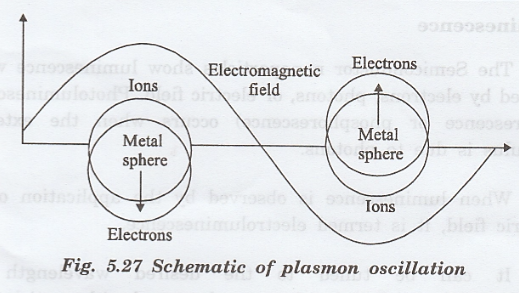
plasmon is the natural oscillation of electron gas inside the nanosphere. It can
appear on the surface of bulk solids, thin films, and nanoparticles. On the surface
of bulk solids, surface plasmons appear as a propagating wave parallel to the surface.
When the nanosphere size is smaller than the wavelength of incident light, the frequency of surface plasmon becomes comparable to the frequency of radiation due to constructive interference. Then a resonance occurs and surface plasmon resonance (SPR) is generated (Fig. 5.27).
Other Factors that Contribute to
Optical Properties
Efficient
energy and charge transfer in nanoscale dimension further contribute to the novel
properties. Linear and nonlinear optical properties of the material can be finely
tuned by controlling their dimension and surface chemistry.
The
optical properties of nanomaterials depend on their size, shape, surface characteristics,
doping, and interaction with the surrounding environment or other nanostructures.
A
change in size of the CdSe semiconductor nanoparticles alters their optical properties.
(A 2.3 nm CdSe emits blue light, whereas a 5.5 nm CdSe emits red light) A change
in the size of metal nanoparticles causes some change in their optical properties.
Quantum Size Effect
Quantum
size effect is most significant in semiconductor nanoparticles. In semiconductors,
the bandgap energy is of the order of a few electron volts.
As the size of the particle increases, absorption shifts towards the shorter wavelength (blue shifts) indicates increase in the bandgap energy.
Luminescence
The
Semiconductor nanoparticles show luminescence when excited by electrons,
photons, or electric field. Photoluminescence (fluorescence or phosphorescence)
occurs when the external stimulus is due to photons.
When
luminescence is observed by the application of an electric field, it is termed electroluminescence.
It
can be tuned to the desired desired wavelength for nanomaterials as their
bandgap can be tuned with particle size.
Nanomaterials
show high quantum efficiency for cathodoluminescence also, in which luminescence
is produced by electrons of very high energy incident on materials.
Finally,
thermoluminescence is very strong for nanomaterials which have defect levels and
larger number of surface atoms that can act as efficient electron/hole traps.
Optical Reflectance
Optical
reflectance is defined by the fraction of incident light reflected from the surface
of a material. Metals show high reflectance. It is due to the presence of a partially
filled conduction band. Thus, absorption and reflection of photons take a continuum
of energies from the infrared to visible region.
Semiconductors,
on the other hand, show low absorption and reflectance in infrared range and
increases drastically at the bandgap and increases further in the ultraviolet
region.
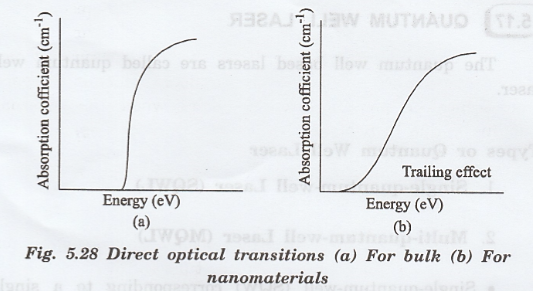
Direct optical transitions for bulk and nanomaterials are shown in fig. 5.28. Absorption edge of nanomaterials denotes trailing effect as compared to bulk due to variation in density of states, surface restructuring and a random distribution of impurities.
Applications Based on Optical
Properties
There
are some fascinating applications of the optical properties of nanomaterials in
the areas of optical detectors, lasers, sensors, imaging, phosphors, displays,
solar cells, photocatalysis, photoelectrochemistry, and biomedicine. Some of
(JWOMM) these applications are listed as follows.
1.
Suitable for optoelectronic materials such as switches, ST 1. amplifiers,
gratings, splitters, isolators, lasers, and detectors
2.
Widely used in polymers to increase their refractive 11.qhta index, which makes
them suitable as optical audt bas components
3.
Useful in preparing abrasion-resistant coatings whose optical clarity can be enhanced
4.
Nanoparticles in castings improve shielding against nedwo electromagnetic
fields in computers
5. LCDs and organic LEDs developed using nanomaterials show better resolution of images.
Physics for Electronics Engineering: Unit V: Nano Devices : Tag: : Nano Devices - Optics in Quantum Structures
Physics for Electronics Engineering: Unit V: Nano Devices
Under Subject
Physics for Electronics Engineering
PH3254 - Physics II - 2nd Semester - ECE Department - 2021 Regulation | 2nd Semester ECE Dept 2021 Regulation
Related Subjects

Professional English II
HS3251 2nd Semester 2021 Regulation | 2nd Semester Common to all Dept 2021 Regulation
Statistics and Numerical Methods
MA3251 2nd Semester 2021 Regulation M2 Engineering Mathematics 2 | 2nd Semester Common to all Dept 2021 Regulation

Engineering Graphics
GE3251 eg 2nd semester | 2021 Regulation | 2nd Semester Common to all Dept 2021 Regulation
Physics for Electrical Engineering
PH3202 2nd Semester 2021 Regulation | 2nd Semester EEE Dept 2021 Regulation

Basic Civil and Mechanical Engineering
BE3255 2nd Semester 2021 Regulation | 2nd Semester EEE Dept 2021 Regulation
Electric Circuit Analysis
EE3251 2nd Semester 2021 Regulation | 2nd Semester EEE Dept 2021 Regulation
Physics for Electronics Engineering
PH3254 - Physics II - 2nd Semester - ECE Department - 2021 Regulation | 2nd Semester ECE Dept 2021 Regulation

Electrical and Instrumentation Engineering
BE3254 - 2nd Semester - ECE Dept - 2021 Regulation | 2nd Semester ECE Dept 2021 Regulation
Circuit Analysis
EC3251 - 2nd Semester - ECE Dept - 2021 Regulation | 2nd Semester ECE Dept 2021 Regulation
Materials Science
PH3251 2nd semester Mechanical Dept | 2021 Regulation | 2nd Semester Mechanical Dept 2021 Regulation

Basic Electrical and Electronics Engineering
BE3251 2nd semester Mechanical Dept | 2021 Regulation | 2nd Semester Mechanical Dept 2021 Regulation

Physics for Civil Engineering
PH3201 2021 Regulation | 2nd Semester Civil Dept 2021 Regulation

Basic Electrical, Electronics and Instrumentation Engineering
BE3252 2021 Regulation | 2nd Semester Civil Dept 2021 Regulation
Physics for Information Science
PH3256 2nd Semester CSE Dept | 2021 Regulation | 2nd Semester CSE Dept 2021 Regulation

Basic Electrical and Electronics Engineering
BE3251 2nd Semester CSE Dept 2021 | Regulation | 2nd Semester CSE Dept 2021 Regulation

Programming in C
CS3251 2nd Semester CSE Dept 2021 | Regulation | 2nd Semester CSE Dept 2021 Regulation