Electrical and Instrumentation Engineering: Unit II: DC Machines
Principle of Operation of Motoring
DC Machines
The basic principle of operation of DC motor is that "whenever a current carrying conductor is placed in a magnetic field, it experiences a force tending to move it".
PRINCIPLE OF OPERATION OF MOTORING
The
basic principle of operation of DC motor is that "whenever a current
carrying conductor is placed in a magnetic field, it experiences a force
tending to move it".
The
magnetic field between two poles, N and S.

A
current carrying conductor along the direction of the flux loops around it is:
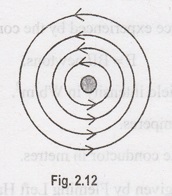
If
a current carrying conductor is placed between two magnetic poles, both the
poles of fields will be distorted.

Above
the conductor, the field is weakened and below the conductor the field is
strengthened. Therefore the conductor tends to move upwards. The force exerted
upwards depends upon the intensity of the main field flux and the magnitude of
the current.

Then
the direction of the current through the conductor is reversed. Here, the field
below the conductor is less (weakened) and field above the conductor is more
(strengthened). Then the conductor tends to move downwards.
The
magnitude of the force experienced by the conductor in a motor is given by:
F
= BIl newtons.
where,
B = Magnetic field intensity in Wb/m2.
I
= Current in amperes.
l =
Length of the conductor in metres.
The
direction of motion given by Fleming Left Hand Rule, which states that if the
thumb, fore finger and middle finger of the left and are held such that the
fingers show three mutually perpendicular directions and if the fore finger
indicates direction of the field, and the middle finger indicates the direction
of current, then the thumb points the direction of motion of conductor.
In
a DC motor, a strong electromagnetic field and a large number of current
carrying conductors housed in an armature, make the armature rotate.
Electrical and Instrumentation Engineering: Unit II: DC Machines : Tag: : DC Machines - Principle of Operation of Motoring
Electrical and Instrumentation Engineering: Unit II: DC Machines
Under Subject
Electrical and Instrumentation Engineering
BE3254 - 2nd Semester - ECE Dept - 2021 Regulation | 2nd Semester ECE Dept 2021 Regulation
Related Subjects
Professional English II
HS3251 2nd Semester 2021 Regulation | 2nd Semester Common to all Dept 2021 Regulation
Statistics and Numerical Methods
MA3251 2nd Semester 2021 Regulation M2 Engineering Mathematics 2 | 2nd Semester Common to all Dept 2021 Regulation
Engineering Graphics
GE3251 eg 2nd semester | 2021 Regulation | 2nd Semester Common to all Dept 2021 Regulation
Physics for Electrical Engineering
PH3202 2nd Semester 2021 Regulation | 2nd Semester EEE Dept 2021 Regulation
Basic Civil and Mechanical Engineering
BE3255 2nd Semester 2021 Regulation | 2nd Semester EEE Dept 2021 Regulation
Electric Circuit Analysis
EE3251 2nd Semester 2021 Regulation | 2nd Semester EEE Dept 2021 Regulation
Physics for Electronics Engineering
PH3254 - Physics II - 2nd Semester - ECE Department - 2021 Regulation | 2nd Semester ECE Dept 2021 Regulation
Electrical and Instrumentation Engineering
BE3254 - 2nd Semester - ECE Dept - 2021 Regulation | 2nd Semester ECE Dept 2021 Regulation
Circuit Analysis
EC3251 - 2nd Semester - ECE Dept - 2021 Regulation | 2nd Semester ECE Dept 2021 Regulation
Materials Science
PH3251 2nd semester Mechanical Dept | 2021 Regulation | 2nd Semester Mechanical Dept 2021 Regulation
Basic Electrical and Electronics Engineering
BE3251 2nd semester Mechanical Dept | 2021 Regulation | 2nd Semester Mechanical Dept 2021 Regulation
Physics for Civil Engineering
PH3201 2021 Regulation | 2nd Semester Civil Dept 2021 Regulation
Basic Electrical, Electronics and Instrumentation Engineering
BE3252 2021 Regulation | 2nd Semester Civil Dept 2021 Regulation
Physics for Information Science
PH3256 2nd Semester CSE Dept | 2021 Regulation | 2nd Semester CSE Dept 2021 Regulation
Basic Electrical and Electronics Engineering
BE3251 2nd Semester CSE Dept 2021 | Regulation | 2nd Semester CSE Dept 2021 Regulation
Programming in C
CS3251 2nd Semester CSE Dept 2021 | Regulation | 2nd Semester CSE Dept 2021 Regulation