Signals and Systems: Unit II: Analysis of Continuous Time Signals,,
Initial Value Theorem and Final Value Theorem
Explanation about Initial Value Theorem and Final Value Theorem
INITIAL
VALUE THEOREM AND FINAL VALUE THEOREM
Initial value theorem
If 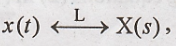 then
initial value of x(t) is written as
then
initial value of x(t) is written as

Proof:
Differentiation property
of Laplace transform is

Take limit δ → ∞ of the
above equation

L.H.S of (2) can be
written as
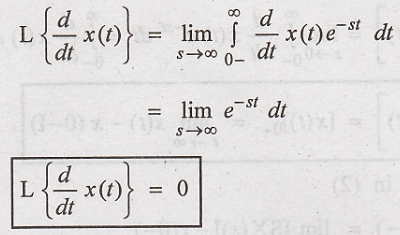
Substitute (3) in (2)

Final Value theorem
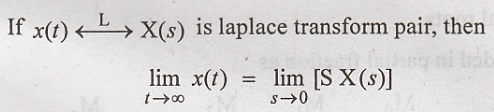
Proof:
Differentiation
property of Laplace transform is given as,

L.H.S of (2) can be
written as
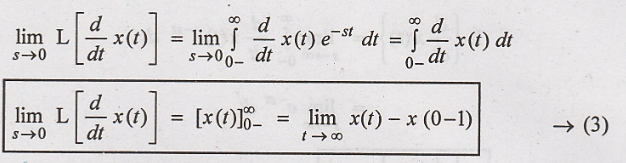
Let us substitute (3)
in (2)
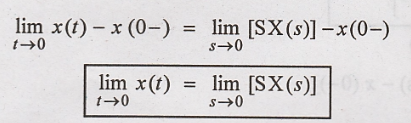
Hence proved.
Signals and Systems: Unit II: Analysis of Continuous Time Signals,, : Tag: : - Initial Value Theorem and Final Value Theorem
Signals and Systems: Unit II: Analysis of Continuous Time Signals,,
Under Subject

Signals and Systems
EC3354 - 3rd Semester - ECE Dept - 2021 Regulation | 3rd Semester ECE Dept 2021 Regulation
Related Subjects
Random Process and Linear Algebra
MA3355 - M3 - 3rd Semester - ECE Dept - 2021 Regulation | 3rd Semester ECE Dept 2021 Regulation
Signals and Systems
EC3354 - 3rd Semester - ECE Dept - 2021 Regulation | 3rd Semester ECE Dept 2021 Regulation
Electronic Devices and Circuits
EC3353 - EDC - 3rd Semester - ECE Dept - 2021 Regulation | 3rd Semester ECE Dept 2021 Regulation
Control Systems
EC3351 - 3rd Semester - ECE Dept - 2021 Regulation | 3rd Semester ECE Dept 2021 Regulation
Digital Systems Design
EC3352 - DSD - 3rd Semester - ECE Dept - 2021 Regulation | 3rd Semester ECE Dept 2021 Regulation