Electronic Devices and Circuits: Unit IV: Feedback Amplifiers and Oscillators
Conditions for Oscillation (Barkhausen Criterion)
Mechanism for Start of Oscillations
The oscillators circuit is set into oscillations by a random variation caused in the base current due to noise component or a small variation in the dc power supply. The noise components ie extremely small random electrical voltages and currents and currents are always present in any conductor, tube or transistor.
CONDITIONS FOR OSCILLATION (BARKHAUSEN CRITERION)
Mechanism for Start of Oscillations
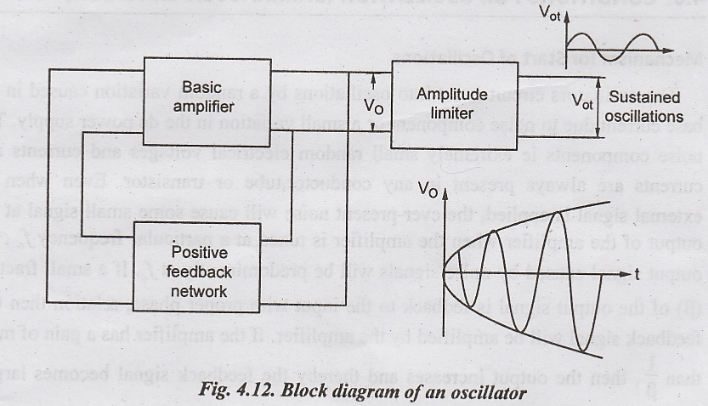
The oscillators circuit is set into oscillations by a random variation caused in the base current due to noise component or a small variation in the dc power supply. The noise components ie extremely small random electrical voltages and currents and currents are always present in any conductor, tube or transistor. Even when no external signal is applied, the ever-present noise will cause some small signal at the output of the amplifier when the amplifier is tuned at a particular frequency fo, the output signal caused by noise signals will be predominantly at fo. If a small fraction (β) of the output signal is fedback to the input with proper phase, relation then this feedback signal will be amplified by the amplifier. If the amplifier has a gain of more than 1/β then the output increases and thereby the feedback signal becomes larger. This process continues and the output goes on increasing. But as the signal level increases the gain of the amplifier decreases and at particular value of output, the gain of the amplifier is reduced exactly equal to 1/β. Then the output voltage remains constant at frequency fo, called frequency of oscillations.
The
essential conditions for maintaining oscillations are
1.
|Aβ|= 1, ie., the magnitude of loop gain must be unity.
2.
The total phase shift around the closed loop is zero (or) 360°.
Practical Considerations
The
condition |Aβ|= 1 gives a single and precise value of Aβ which should be set
through out the operation of the oscillator circuit. But in practice, as
transistor characteristics and performance of other circuit components change
with time, |Aβ| will become greater or less than unity. Hence, in all practical
circuits |Aβ| should be set greater than unity so that the amplitude of
oscillation will continue to increase without limit but such an increase in
amplitude is limited by the onset of the nonlinearity of operation in the
active devices associated with the amplifier as shown in Fig. 4.12.
In
this circuit, Aβ is larger than unity for positive feedback. This onset of
nonlinearity is an essential feature of all practical oscillators.
Electronic Devices and Circuits: Unit IV: Feedback Amplifiers and Oscillators : Tag: : Mechanism for Start of Oscillations - Conditions for Oscillation (Barkhausen Criterion)
Electronic Devices and Circuits: Unit IV: Feedback Amplifiers and Oscillators
Under Subject

Electronic Devices and Circuits
EC3353 - EDC - 3rd Semester - ECE Dept - 2021 Regulation | 3rd Semester ECE Dept 2021 Regulation
Related Subjects
Random Process and Linear Algebra
MA3355 - M3 - 3rd Semester - ECE Dept - 2021 Regulation | 3rd Semester ECE Dept 2021 Regulation

Signals and Systems
EC3354 - 3rd Semester - ECE Dept - 2021 Regulation | 3rd Semester ECE Dept 2021 Regulation
Electronic Devices and Circuits
EC3353 - EDC - 3rd Semester - ECE Dept - 2021 Regulation | 3rd Semester ECE Dept 2021 Regulation
Control Systems
EC3351 - 3rd Semester - ECE Dept - 2021 Regulation | 3rd Semester ECE Dept 2021 Regulation

Digital Systems Design
EC3352 - DSD - 3rd Semester - ECE Dept - 2021 Regulation | 3rd Semester ECE Dept 2021 Regulation